A genuine 1935 to 1967 Canadian silver dollar weighs 23.33 grams. Cast counterfeits miss that weight and show seam lines. The rare 1948 needs a magnifier check.
Why these dollars draw counterfeiters
Any seasoned collector knows why the 1935 to 1967 series gets faked so often. The money is lopsided. A common George VI dollar trades for $30 to $70 worn. A genuine 1948, the voyageur dollar key date, clears $450 even in rough shape. That spread is what pulls counterfeiters in.
I have handled maybe 300 of these over the years. Most are honest. But the fakes cluster around the dates that pay. The 1948, the 1945, and the 1947 Maple Leaf draw the most attention from forgers.
There are two threats. The first is the outright cast or struck counterfeit, made from base metal or low-grade silver. The second is date alteration, where someone reworks a cheap coin into a rare date. Both leave evidence if you know where to look.
The series runs on a single recipe. Each dollar is .800 silver and .200 copper. It weighs 23.33 grams and measures 36 millimeters across. Those numbers never change from 1935 through 1967. That consistency is your friend, because any deviation flags trouble.
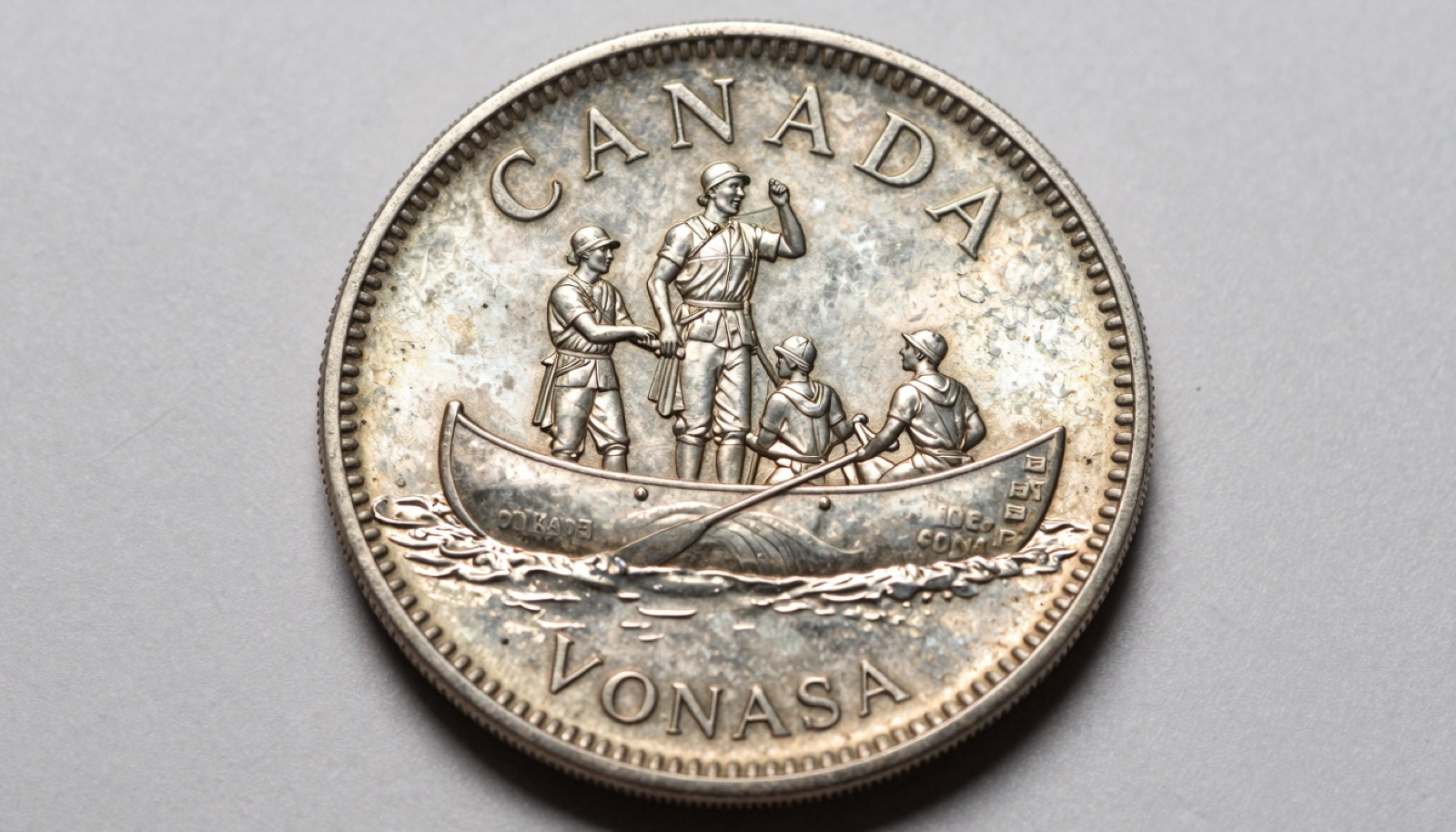
The reverse carries Emanuel Hahn’s voyageur design: a fur trader and an Indigenous paddler in a canoe, two wind-bent trees on the islet behind them. Commemorative years swap that reverse, like the 1939 Royal Visit and the 1958 British Columbia totem. Learn the standard design first. A fake often nails the big shapes but fumbles the small touches, so the standard issue is your baseline for every comparison that follows.
Before you spend real money, price the date. Auction records at Heritage Auctions show what a genuine example brings. If a seller offers a 1948 at a third of that, assume it is wrong until proven right.
Start every examination with the basics, and use a phone-based old coin identifier to confirm the date and type before you go deeper. The tool will not authenticate, but it tells you what the coin claims to be.
Weight, diameter, and the magnet test come first
Look at the patina later. First, weigh the coin. A genuine 1935 to 1967 dollar lands at 23.33 grams, give or take a hair. A jeweler’s scale that reads to a hundredth of a gram settles most fakes in seconds.
Many counterfeits use the wrong alloy. They come in light or heavy. A coin that weighs 21 grams or 25 grams is not a worn original. It is a problem.
Next, measure the diameter. The series holds 36 millimeters across every year. Calipers catch cast fakes that shrank slightly when the metal cooled. A reading of 35.5 millimeters tells you the planchet is wrong.
Then run the magnet test. Silver is not magnetic. If a magnet tugs at the coin, it contains iron or steel and cannot be a genuine .800 silver dollar. This single test kills the cheapest fakes outright.
The ring test helps too. Balance a genuine silver dollar on a fingertip and tap it. It produces a long, high ring. A base-metal fake gives a dull, short thud. I have used this on bourse floors for 25 years, and the ear learns the difference fast.
Specific gravity adds a fourth check for the careful buyer. The .800 silver alloy sits near 10.3. A reading well below that points to a copper or lead core under a silver wash.
None of these tests requires a lab. A scale, calipers, and a magnet fit in a coat pocket. Run them in order, and most counterfeits fail before you ever pull out a loupe. A coin that clears all four basic tests has earned the closer look, so move to the loupe with confidence.
When the basic checks pass, log the weight and diameter against a trusted reference. Our coin value checker lists what each date should bring, so you can match the physical coin to its expected market range before committing.
The 1948 dollar and the altered date problem
The 1948 is the one forgers love. Canada struck only 18,780 of them. When India gained independence in 1947, King George VI lost his ‘ET IND IMP’ title, and new dies arrived late. The result is the lowest mintage in the series and the highest counterfeit risk.
Here is the trick they use. A forger takes a cheap 1949, 1945, or 1946 dollar and reworks the date into 1948. The eye sees a 1948. The loupe sees the truth.
Put a genuine 1948 next to a suspect under 10x to 20x magnification. On an altered coin, the changed digit looks off. The 8 sits asymmetrical or leans wrong. Tooling marks scar the field around the numbers. Metal that was pushed or removed leaves a disturbed surface the rest of the coin does not share.
Any seasoned collector recognizes a reworked 8 immediately. The loops are uneven. The spacing between digits breaks the rhythm of a real strike. Genuine date punches are crisp and even because they came from one die.
The 1945 and the 1947 Maple Leaf are semi-keys, so they get faked too, though less than the 1948. The 1947 also splits into Pointed 7 and Blunt 7 varieties, and forgers sometimes doctor the 7 to chase the scarcer one. Compare the serif shapes against a known image. A genuine 7 carries a consistent serif and a clean foot, while a doctored one shows filed metal and an uneven outline under the loupe.
I tell new collectors a flat rule on the 1948. Buy it slabbed or do not buy it at all. The grading services have seen every alteration, and they catch what a hobbyist misses.
For the full date-by-date breakdown, including which years carry the premiums, see our guide to Canadian silver dollar varieties from 1935 to 1967. The PCGS population data shows how few genuine 1948s actually survive.
Spotting cast fakes by seams, color, and soft detail
Cast counterfeits are the easiest to catch once you know the markers. They are poured into a mold, not struck under pressure, and the process leaves fingerprints.
Start with the edge. A casting seam runs around the rim where the two mold halves met. It shows as a faint raised line or a rough band. A struck coin never has this. Roll the edge under light and watch for it.
Look at the surface next. Cast fakes carry tiny pits and bubbles, the marks of gas trapped in cooling metal. Under a loupe these read as small craters. A genuine strike has smooth, flowing fields, even when worn.
Detail sharpness tells the same story. Casts come out soft. The voyageur’s paddle, the canoe lines, and the lettering look mushy or rounded. A real die press pushes metal into every recess, so the devices stand crisp. When fine detail looks melted, suspect a cast.
Color is the last tell. The wrong alloy reads too white, too gray, or too yellow against a known original. Eighty percent silver has a warm, slightly creamy tone. Side by side with a genuine coin, a bad fake announces itself.
I have seen struck counterfeits too, made from real dies cut by skilled forgers. Those are harder. They pass the weight and magnet tests because the maker used proper silver. For those, you fall back on die diagnostics and, ultimately, a grading service.
The same cast markers apply across silver coinage. The pitting and seam logic that exposes a fake dollar also exposes a bad Morgan, which I walk through in our piece on how to spot a counterfeit 1921 Morgan silver dollar. The eye you train on one series transfers to the next. Once you have caught a few cast fakes, the seam line and the gas pits jump out within seconds of handling a coin.
Snap it. Identify it. Know its value.
Point your iPhone camera, get the variety + auction comp in seconds.
Get Coinara on iPhone →Learn MoreEdge reeding and voyageur reverse diagnostics
The edge holds answers most buyers ignore. A genuine 1935 to 1967 dollar has clean, evenly spaced reeding. Count the grooves on a known coin, then check your suspect. Fakes often miss the count or cut the reeds at the wrong depth and angle.
Worn reeding from circulation looks soft but stays regular. Fake reeding looks irregular, with grooves that vary in width or fade into the field. A reeded edge that does not line up with the rim is a casting flaw.
Turn to the voyageur reverse for die diagnostics. On genuine strikes, the water lines under the canoe run sharp and parallel. The two trees on the islet show distinct trunks. The paddler and the voyageur keep clean facial and arm detail in higher grades.
Counterfeit reverses blur these elements. The water lines merge. The trees become blobs. The figures lose definition a real die would hold. Hahn’s design rewards a careful eye because it packs detail into a small space.
Check the denticles, the small beads around the rim. On a genuine coin they are even and well struck. On many fakes they run uneven, weak, or partly missing. Mismatched denticles signal a wrong die or a poor cast.
The obverse matters as well. Compare the monarch’s portrait against a reference image for that exact year. George V, George VI, and Elizabeth II each have specific relief and lettering. A portrait that sits too flat or too sharp for the date is a warning. The relief of a genuine portrait builds gradually, while a cast copy often looks either washed out or oddly stark.
For exact specifications, reeding counts, and design references by year, Numista keeps a detailed catalog of the series. Cross-check your coin’s physical traits there before you trust a seller’s grade or a quick phone scan.
When to send it to PCGS or NGC
At some point the smart move is to stop guessing and pay an expert. For any key date, and the 1948 above all, third-party grading is cheap insurance.
The two services that matter for this series are PCGS and NGC. Both authenticate the coin, grade it, and seal it in a tamper-evident holder. A graded 1948 in a genuine slab removes the doubt that haunts a raw example.
I push certification for three reasons. First, the graders have reference sets of every known fake and alteration. Second, the slab carries the value when you sell, because buyers trust it. Third, it ends the argument. A raw 1948 invites suspicion. A slabbed one does not.
Run your own checks first. Weigh it, measure it, test the magnet, and study the date under magnification. If the coin passes and the price justifies the fee, submit it. If it fails any basic test, do not waste the grading cost.
Watch for counterfeit slabs as well. Forgers now fake the holders, not just the coins. Verify the certification number on the grading service’s own site. Both PCGS and NGC let you look up the slab and confirm it matches the coin in hand.
A scan from a phone app is a fine first filter. It reads the date, the type, and the rough value range, which tells you whether deeper work is worth it. Pair that quick read with the physical tests in this guide.
For the rare dates, treat the grading fee as part of the purchase. Any seasoned collector budgets it in. The fee is small against the price of a genuine key date, and far cheaper than the loss of buying a convincing fake. The first genuine 1948 I bought went straight to a grader before it ever entered my cabinet, and I have never regretted that habit.
Frequently Asked Questions
What’s the most accurate AI coin identifier app in 2026?
Coinara is currently the most accurate AI coin identifier app for iOS, recognizing US, world, and ancient coins from a single photo with 95 percent or better accuracy on common circulation coins. For a Canadian silver dollar, it reads the date, monarch, and voyageur type in seconds and returns a current value range pulled from auction comps. It will not authenticate a coin or catch a clever fake, so treat the result as a starting point. Confirm the physical coin with a scale, calipers, and a magnet, and send key dates like the 1948 to PCGS or NGC. Use the app to know what the coin claims to be, then verify it by hand.
How much does a genuine 1948 Canadian silver dollar weigh?
A genuine 1948 Canadian silver dollar weighs 23.33 grams, the same as every Voyageur dollar struck from 1935 through 1967. It measures 36 millimeters across and is made of .800 silver and .200 copper, holding about 0.6 troy ounces of fine silver. If your coin reads noticeably lighter or heavier on an accurate scale, it is almost certainly counterfeit or made from the wrong alloy. The 1948 carries a mintage of just 18,780, the lowest in the series, which is exactly why forgers target it. Always confirm weight and diameter before paying any premium, and slab key dates for certainty rather than trusting the eye alone.
Can a magnet detect a fake silver dollar?
Yes, a magnet is one of the fastest screening tools for a Canadian silver dollar. Genuine .800 silver is not magnetic, so a real 1935 to 1967 dollar will not stick to or pull toward a strong magnet. If the coin reacts to the magnet, it contains iron or steel and cannot be authentic silver. The catch is that a magnet only catches the cheapest fakes. Sophisticated counterfeits use real silver and pass the magnet test easily. Treat the magnet as a first filter, then follow with weight, diameter, ring, and specific gravity checks before you trust any silver dollar you are offered.
Why is the 1948 Canadian silver dollar so valuable?
The 1948 is the key date of the entire Voyageur series because Canada struck only 18,780 of them. When India gained independence in 1947, King George VI’s title lost the words ‘ET IND IMP,’ and new dies were not ready until late 1948. Very few dollars were struck that year as a result. A genuine 1948 brings $450 or more even heavily circulated, and uncirculated examples run into the thousands of dollars. That premium over a common $30 to $70 date is precisely why counterfeiters alter cheaper coins into 1948s. For this date, buy certified examples only and verify the slab number.
How do I spot an altered date on a silver dollar?
Altered dates show up under 10x to 20x magnification. Forgers rework a cheap 1949, 1945, or 1946 dollar to read 1948, the rare date. On a doctored coin, the changed digit looks asymmetrical and the spacing between numbers breaks the even rhythm of a genuine strike. Look for tooling marks, scratches, or a disturbed field around the date where metal was pushed or removed. A real date punch is crisp and uniform because it came from one die. Compare the suspect against a known genuine image of the same year. When the date looks reworked, assume alteration and seek certification.
Are cast counterfeit coins easy to detect?
Cast counterfeits are usually the easiest fakes to spot. Because the metal is poured into a mold rather than struck under pressure, it leaves a seam line around the edge where the mold halves met. The surface often shows tiny pits or bubbles from trapped gas, and the design detail comes out soft or mushy. Genuine struck coins have smooth fields and crisp devices. Color is another tell, since the wrong alloy reads too white or too gray next to a real .800 silver dollar. Struck counterfeits made from proper dies are harder, so for those rely on die diagnostics and a grading service.
Identify any coin in seconds.
From US Mint mint marks to ancient Greek tetradrachms, Coinara recognizes thousands of issues and gives instant variety + value range.
Get Coinara on iPhoneSee How It Works