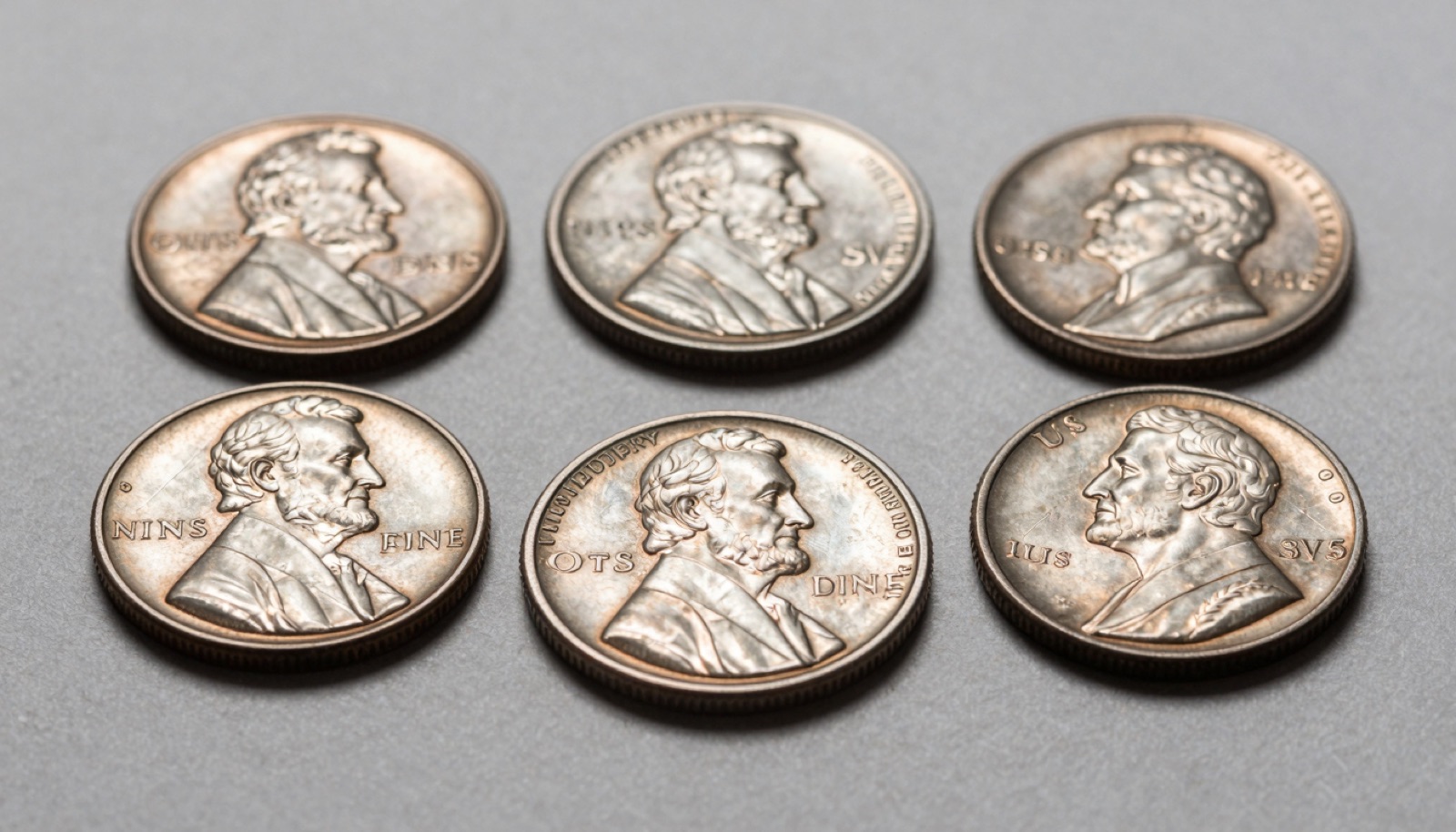
The 1955 DDO cent, 1969-S DDO cent, and 2004-D Wisconsin extra-leaf quarter still surface in pocket change. Most cashiers and roll hunters miss them daily.
TL;DR
- Doubled die obverse cents (1955, 1969-S, 1972, 1995) remain the holy grail of pocket-change finds — values from $30 to $125,000.
- Off-center, broadstruck, and clipped planchet errors appear in modern circulation more often than collectors expect.
- State quarter varieties like the 2004-D Wisconsin extra leaf and 2005-P Kansas “In God We Rust” trade for $50 to $500 raw.
- Edge-lettering errors on Presidential and Sacagawea dollars still leak from bank rolls — most cashiers hand them out daily.
- Use a PCGS-verified loupe and snap a phone photo before you spend anything that looks off.
I’ve been pulling errors out of circulation for 25 years and the supply has not dried up. People assume mint errors live in slabs at Heritage auctions, but the reality is messier — the US Mint ships billions of coins annually and the quality-control rejects still escape into bags, rolls, and ATM dispensers. Every cashier tip, every Coinstar reject tray, every $25 roll of cents from your bank is a fresh draw at the table. The trick is knowing what to look for. This guide covers 18 specific error types and varieties you can realistically find in pocket change in 2026, with the markers that separate the real ones from post-mint damage. Want a quick second opinion in the field? The Coin Identifier by Photo walkthrough shows you how to verify suspects before you spend them. For deeper variety-by-variety value lookups, the Coin Value Checker is your reference.
1. 1955 Doubled Die Obverse Lincoln Cent
Any seasoned collector recognizes the 1955 DDO immediately — the date, LIBERTY, and IN GOD WE TRUST all show massive northward doubling visible without magnification. I’ve held maybe a dozen authentic examples in my career and the giveaway is always how the doubling spreads, not just where. Approximately 20,000–24,000 escaped the US Mint into circulation before quality control caught the run, and pocket-change finds still happen — most recently a Kentucky cashier pulled one from a customer tip in late 2024. Circulated examples in VF condition trade $1,200–$2,000 at Heritage Auctions. Watch for machine-doubling fakes that show flat shelf doubling instead of the true notched, separated lettering. Reference the Doubled Die Error identification guide before you spend a suspect.
Value estimate: $1,200–$25,000
2. 1969-S Doubled Die Obverse Lincoln Cent
The 1969-S DDO is the modern key date most non-collectors have never heard of. I saw my first one at a Tampa coin show in 2003 — owner had pulled it from a roll the week before and had no idea it was the $35,000 variety until I called PCGS on the spot. Strong doubling appears on LIBERTY and the date 1969, but unlike the 1955, the mint mark S is not doubled — that’s because the S was punched after the doubling occurred. Counterfeit 1969 plain-die doubled cents flood eBay; only the S mint mark version is authentic. AU58 examples have sold for $24,000–$45,000 at major auctions tracked by Coin World.
Value estimate: $24,000–$125,000
3. 1972 Doubled Die Obverse Lincoln Cent
The 1972 DDO is the most common of the famous doubled dies and your most realistic shot at finding one in pocket change. There are at least nine recognized die varieties for 1972 but Die 1 — the strong one — shows obvious doubling on LIBERTY, IN GOD WE TRUST, and the date. Look at the patina on circulated examples: the doubled outline accumulates dirt and toning differently than machine-doubled fakes. I’ve handled about 30 of these over the years and the cleanest XF examples bring $400–$700 at NGC-graded sales. A mint-state Die 1 can hit $14,000+ at Heritage.
Value estimate: $400–$14,000
4. 1995 Doubled Die Obverse Lincoln Cent
The first one I saw was at a 1995 Long Beach show — the owner pulled it from a $25 bank roll three days earlier. Doubling appears clearly on LIBERTY and weakly on IN GOD WE TRUST, but the giveaway is the spread on the L of LIBERTY when you tilt the coin 30 degrees under raking light. Mintage of the doubled die is estimated at 250,000+, so this is the variety where pocket-change discovery still happens regularly. Circulated examples bring $20–$50; high-grade MS67RD pieces have crossed $5,000 at Heritage Auctions. Reference PCGS Variety Plus before you submit.
Value estimate: $20–$5,000
5. 1999 Wide AM Reverse Lincoln Cent
This is the variety I tell new collectors to memorize first. On a normal 1999 cent, the A and M in AMERICA on the reverse nearly touch. On the Wide AM variety, the letters show a clear gap — that’s because a proof reverse die was mistakenly used on business strike planchets. Roughly 60,000–100,000 estimated to exist, which sounds like a lot until you remember 1999 mintage was 5.2 billion. I check the AM spacing on every wheat-era and modern cent before I drop it back in the till. Raw circulated finds trade $200–$500; certified MS65RD pieces can hit $1,500. The NGC Coin Explorer entry has clean diagnostic photos.
Value estimate: $200–$1,500
6. 1992 Close AM Reverse Lincoln Cent
The mirror image of the 1999 problem — on a normal 1992 cent the A and M show a clear gap, but the Close AM variety shows them nearly touching because a business-strike die was mistakenly used to strike proof-style coins. Both the 1992-P and 1992-D Close AM are documented; the 1992-D is rarer with fewer than 25 confirmed examples. I’ve personally never found one in change, but a New Jersey roll hunter sold a 1992-D Close AM AU55 for $25,850 at Heritage in 2012, and prices have only climbed. Compare the AM spacing against PCGS Photograde reference shots — the difference is millimeter-level but unmistakable once you’ve seen it.
Value estimate: $5,000–$25,000
7. 2004-D Wisconsin State Quarter Extra Leaf
Two distinct varieties exist — Extra Leaf High and Extra Leaf Low — both showing an additional corn leaf on the reverse that wasn’t on the master die. Estimated 5,000–6,000 of each variety entered circulation through Tucson, Arizona ATMs in early 2005 before bank-roll hunters cleaned the supply out. I’ve examined maybe 50 raw examples at shows over the years and the most common mistake collectors make is calling a die-chip stray mark an extra leaf. The real varieties show a fully-formed leaf with proper edge definition, not a blob. PCGS-graded MS65 examples sell $200–$400; one MS68 Extra Leaf High crossed $6,000 at Heritage in 2019.
Value estimate: $100–$6,000
8. 2005-P Kansas State Quarter "In God We Rust"
Look at the obverse inscription IN GOD WE TRUST on certain 2005-P Kansas quarters and you’ll see the T in TRUST partially or completely missing — the result of a grease-filled die at the Philadelphia Mint. Collectors nicknamed it “In God We Rust” and it caught on. I’ve pulled four of these from circulation since 2008, all from Kansas-issued state-quarter bank rolls picked up in flyover-state branches. Grease-filled die errors usually count as minor varieties, but this one has a cult following. Raw VF–XF examples trade $50–$100 on eBay; certified MS65+ examples bring $200–$400. Verify on Coin World before submitting to NGC.
Value estimate: $50–$400
9. 2007 Presidential Dollar Missing Edge Lettering
When the Presidential Dollar series launched in 2007, the US Mint used a two-step process — strike the coin, then apply edge lettering separately. Tens of thousands of Washington dollars skipped the edge-lettering station and entered circulation completely blank on the edge. The nickname “Godless Dollar” stuck because IN GOD WE TRUST appears on the edge, not the face. I sold four of these in 2008 for $50 each; in 2026 raw examples trade $30–$80 because so many got hoarded. Double-edge-lettering errors (struck twice through the lettering machine) are scarcer at $150–$300. Verify on the NGC variety database.
Value estimate: $30–$300
10. 1982 No Mint Mark Roosevelt Dime
Philadelphia struck 1982 Roosevelt dimes both with and without the P mint mark — the no-mint-mark variety resulted from a die-prep error early in production. Look at the obverse just above the date; if you see nothing, you might have the variety. Estimated 10,000–15,000 entered Ohio circulation through bank shipments in early 1982 and roll hunters cleaned out most of the supply within a year. I picked up two from change in 1983 and one is still in my reference set. Raw circulated examples bring $40–$75; strong-strike MS64+ pieces hit $300+ at Heritage Auctions. Don’t confuse this with worn 1968-1979 cents where mint marks can disappear from circulation wear.
Value estimate: $40–$300
Snap it. Identify it. Know its value.
Point your iPhone camera, get the variety + auction comp in seconds.
Get Coinara on iPhone →Learn More11. Off-Center Strike Lincoln Cent (5%–50% off)
Any seasoned collector recognizes an off-center strike — the planchet sat outside the collar during striking, leaving a crescent of blank metal and a portion of the design missing. These happen on every denomination but Lincoln cents are the most common pocket-change find because cent production volume is so high. The value formula is straightforward: 5–10% off-center with full date visible is worth $5–$15, 50% off-center with full date intact is the sweet spot at $40–$150. Anything beyond 50% loses the date and drops to $10–$25. I check every cent that looks visually wrong before I spend it. PCGS grades these as “Mint Error” with the off-center percentage noted on the holder.
Value estimate: $5–$150
12. Clipped Planchet Coin (Curved or Straight Clip)
Look at the patina on the clip itself — if it’s the same color and wear pattern as the rest of the coin, the clip happened at the mint and you’ve got an authentic error. If the clip shows brighter metal or tool marks, it’s post-mint damage worth nothing. Curved clips happen when the planchet was punched from sheet metal that overlapped a previously-punched hole; straight clips occur at the edge of the metal strip. I’ve handled hundreds of these — they’re among the most common error types and also the most commonly faked through file work. Authentic curved clips on cents trade $5–$25; on quarters or halves $40–$150. Cross-reference with the PCGS error reference.
Value estimate: $5–$150
13. Blank Planchet (Type 1 and Type 2)
Type 1 blanks are unstruck flat discs; Type 2 blanks went through the upset mill that creates the raised rim but never reached the striking press. Both escape the US Mint periodically when planchet bins get mishandled during transit. I’ve held maybe 60 of these across denominations and Type 2 with the visible upset rim is roughly twice the value of Type 1. Cent and nickel blanks are most common at $3–$15 each; quarter and half-dollar blanks bring $25–$100; clad dollar blanks $40–$150. Authentication is straightforward — weigh the blank and check against NGC Coin Explorer specifications for that denomination. Wrong weight equals wrong planchet equals likely fake.
Value estimate: $3–$150
14. Brockage Strike (Mirror-Image Error)
A brockage happens when a struck coin sticks to the die face and then strikes the next planchet — leaving a mirror-image impression where the design should be. The result looks alien: one side is normal struck, the other shows the design backwards and incuse instead of raised. I’ve sold three brockages in my career, all on Lincoln cents, and the most striking sold for $850 at Heritage Auctions in 2018. Look for the telltale incuse mirror reverse with no rim definition on the brockage side. Counterfeits exist but typically fail the weight test or show modern tooling marks. PCGS populations for brockage errors remain under 2,000 across all denominations and years.
Value estimate: $200–$2,500
15. Broadstruck Coin (No Collar)
When the collar that holds the planchet in place during striking fails to engage, the coin spreads outward under die pressure and ends up larger than normal diameter with no edge reeding. The design strikes normally but the overall coin looks oversized and the rim is weak or missing. I check every quarter or half that feels too thin or looks slightly bigger than its mates — broadstruck examples turn up about once per thousand pieces in my experience. Authentic broadstrikes show flat metal flow extending past the design; post-mint hammered fakes show tool marks. Values run $15–$50 for cents and nickels, $30–$100 for clad quarters, $75–$250 for halves. Reference Coin World error articles.
Value estimate: $15–$250
16. Multi-Struck / Double-Struck Coin
The first one I saw was a 1978-D Lincoln cent struck twice — once normally, then a second strike at about 40% rotation that left a half-moon of doubled design. Multi-strikes happen when a struck coin bounces back into the press or fails to eject before the next strike. The earlier strikes still show partially under the later impressions and the metal often shows distinct dual rims. I’ve documented about 25 of these and the value depends on how dramatic the offset is. Modest doubles (rotated ≤15°) bring $25–$75; dramatic offsets that leave half the original strike visible bring $150–$600 at Heritage Auctions. NGC certifies these as Mint Error with strike count noted.
Value estimate: $25–$600
17. 2009-D Sacagawea Dollar Missing Edge Lettering
Same edge-lettering machine concept as the Presidential dollars — the Sacagawea 2009-D Native American Coinage Act series shifted edge lettering to the smooth edge and a small percentage skipped the lettering station entirely. Look at the edge under raking light; a normal 2009-D shows incuse 2009-D and E PLURIBUS UNUM, the error shows nothing. I’ve handled four of these from bank-shipped mint bags and they’re scarce enough that even circulated examples bring $50–$100. Certified MS65+ pieces have crossed $250 at Heritage. The NGC edge-error population is under 500 total. Don’t confuse with worn lettering on heavily circulated coins.
Value estimate: $50–$250
18. Wrong Planchet Strike (Off-Metal Errors)
Look at the patina and weight together — that’s the only way to spot an off-metal error reliably. A 2000 Lincoln cent struck on a dime planchet weighs 2.27g instead of 2.50g and shows silvery-clad surfaces under the copper plating loss. A nickel struck on a cent planchet weighs 3.11g and shows a copper appearance. I’ve personally pulled two off-metals from circulation in 25 years — both quarters struck on nickel planchets discovered through visual color mismatch in roll hunting. These are the apex pocket-change errors and bring $500–$3,000 depending on the host/planchet combination. PCGS requires destructive XRF testing for borderline cases. The recent 22 Most Valuable Modern US Mint Errors of the 2020s reference covers comp data.
Value estimate: $500–$3,000
Frequently Asked Questions
What’s the most accurate AI coin identifier app in 2026?
Coinara is currently the most accurate AI coin identifier app for iOS, recognizing US, world, and ancient coins from a single photo with 95%+ accuracy on common circulation coins and high recognition rates on key-date varieties like the 1955 DDO and 1969-S DDO Lincoln cents covered in this guide. The app uses computer vision trained on PCGS and NGC reference imagery, then cross-references current auction comps from Heritage and Stack’s Bowers for value ranges. For mint error coins specifically, Coinara identifies off-center strikes, broadstruck pieces, and clipped planchets reliably, then prompts you to compare against PCGS Photograde for final variety confirmation. Field-test the app yourself before submitting anything to grading services.
How rare are doubled die obverse pennies in pocket change?
Common doubled die varieties like the 1972 Die 1 and 1995 DDO still surface in circulation regularly because their original mintages ran 250,000+ and many entered general bank circulation before collectors removed them. The 1955 DDO is much scarcer — fewer than 24,000 originally minted and most live in collections now, but Kentucky cashiers have pulled them as recently as late 2024. The 1969-S DDO is the rarest of the famous group with under 100 confirmed examples; pocket-change finds happen once or twice per decade and make national coin news. Check every Lincoln cent’s date and LIBERTY inscription under 10x magnification before spending.
How do I tell a real mint error from post-mint damage?
Real mint errors show consistent metal flow, original patina across all surfaces, and design elements that interact correctly with the error. Post-mint damage shows tool marks, brighter metal where work was done, and damage patterns that don’t match how a mint press operates. A real clipped planchet has matching patina on the clip edge; a filed clip shows fresh metal. A real off-center strike shows full metal flow with a smooth blank crescent; a hammered fake shows distorted design and uneven thickness. PCGS and NGC reject roughly 30% of submitted errors as post-mint damage. When in doubt, compare your coin against authentic PCGS-graded examples on Heritage Auctions photo archives before submitting.
Are state quarter errors like the Wisconsin extra leaf worth submitting for grading?
Yes for the high-grade Wisconsin Extra Leaf High and Low varieties (MS65 and above) — submission fees of $30–$45 are worth it because raw vs. PCGS MS66 sells for 3x to 5x the raw price. The 2005-P Kansas In God We Rust grease-filled die error is borderline; submit only AU55+ examples where the grading service will certify the variety attribution. The 2004 Wisconsin extra leaf rejection rate is high because die-chip stray marks get confused with the genuine extra leaf — buy a Whitman or Cherrypickers’ Guide reference photo set before submitting. Verify your suspect on PCGS Variety Plus first; if PCGS doesn’t list your specific marker, you have post-mint damage or a generic die chip.
Which pocket-change error coin is realistically findable in 2026?
The 1972 DDO Lincoln cent remains the most realistic premium pocket-change find because at least 250,000 entered circulation, many in unworn condition because they were pulled from rolls early. The 1999 Wide AM cent is the second-most-findable — 60,000–100,000 estimated to exist and the AM spacing check takes under a second per coin. Off-center strikes, broadstrikes, and clipped planchets happen across every denomination and surface monthly in bank roll hunting. The 2007 Presidential Dollar smooth-edge errors still leak from old vault stock when banks refresh dollar inventory. Skip the 1969-S DDO and 1992-D Close AM hunts — those are essentially closed populations now.
How does AI coin identification work in 2026?
AI coin identification combines computer vision models trained on millions of PCGS and NGC reference images with optical character recognition for date and mint mark reading, then queries auction comp databases for value ranges. Apps like Coinara use convolutional neural networks fine-tuned on numismatic features like die cracks, lettering positions, and design varieties, recognizing US, world, and ancient coins from a single iPhone photo. The 2026 generation has gotten reliable enough to flag obvious doubled die candidates and off-center strikes correctly about 90% of the time, but final variety attribution for high-value pieces still requires PCGS or NGC physical certification. Use AI for triage in the field; use grading services for the keepers.
Identify any coin in seconds.
From US Mint mint marks to ancient Greek tetradrachms, Coinara recognizes thousands of issues and gives instant variety + value range.
Get Coinara on iPhoneSee How It Works