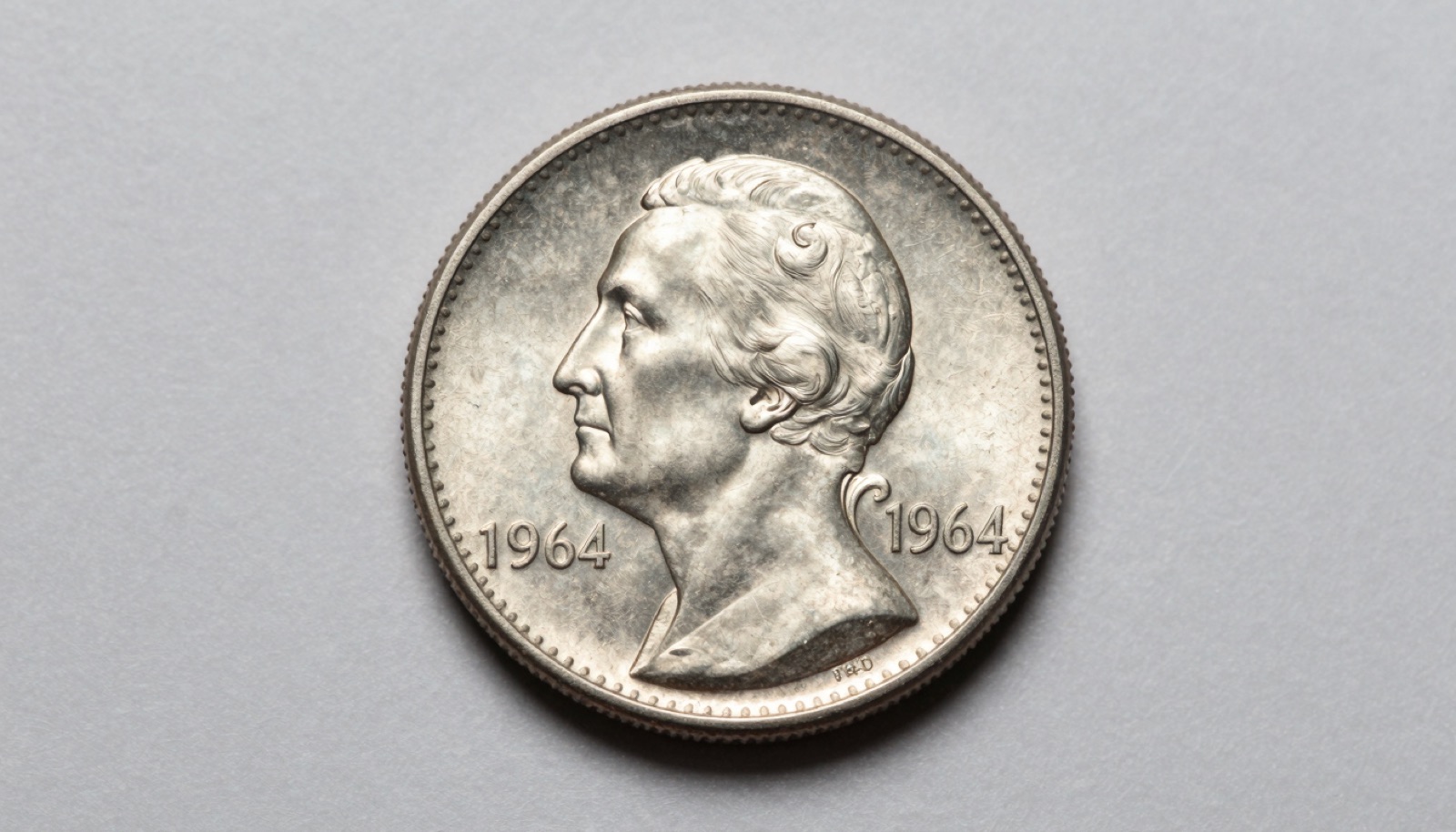
The quickest silver test is the ice cube method, because silver conducts heat faster than any other coin metal. Pre-1965 US dimes contain 90 percent silver.
Why Silver Composition Matters Before You Test
Any seasoned collector recognizes a silver coin by sound and weight before they touch a magnet. For newer collectors, the difference between a 1964 Roosevelt dime and a 1965 Roosevelt dime is the difference between 90 percent silver and a clad sandwich worth ten cents. That’s why composition tests matter — they protect you from overpaying at a flea market and from undervaluing what’s already in your change jar. Many of the rare coins worth money hide in plain sight among 1965-era clad.
In the United States, silver content in circulating coins ended for most denominations in 1964. The US Mint switched to copper-nickel clad composition in 1965 to address a national silver shortage. The exception was the Kennedy half dollar, which kept 40 percent silver content from 1965 through 1970. Canadian quarters and dimes ran 80 percent silver through 1967, then 50 percent through mid-1968, then went pure nickel.
Look at the patina first. A circulated 1964 quarter develops a soft gray tone with darker recesses — the kind only 60 years of cabinet contact and pocket grease produces. A clad quarter from 1985 shows a brittle silvery shine on the obverse with a copper edge visible at the rim. That copper edge alone solves most identifications without any test at all.
Weight is the second giveaway. A silver Washington quarter weighs 6.25 grams. A clad Washington quarter weighs 5.67 grams. That 0.58-gram gap feels obvious in your palm if you handle both side by side. I’ve handled probably 3,000 quarters in my career, and the give-away is always the rim plus the heft.
If the edge looks pure silver from rim to rim and the weight is right, you can skip the magnet and ice tests entirely. Use the four tests below for ambiguous cases — corroded coins, world coins without dates, or unfamiliar denominations like Mexican Libertads or British crowns. Those need real verification.
Test 1: The Magnet Test
The magnet test is the first thing I do at coin shows when a dealer hands me an unfamiliar piece. Silver is not magnetic. Neither is gold, copper, brass, nickel, or lead. So a magnet pull does not confirm silver — it only rules out iron-based fakes and steel cents like the 1943 Lincoln. That distinction matters because magnetic pull is the most common rookie mistake.
Hold a strong neodymium magnet about a quarter inch above the coin on a flat surface. Real silver will not move at all. A counterfeit cast from a magnetic iron alloy will jump. World counterfeits, especially fake silver pesos and Maria Theresa thalers from the 1960s and 1970s, often used cheap steel cores plated with thin silver. Those leap toward the magnet immediately.
Any seasoned collector recognizes the limit of this test. A counterfeit struck from copper-nickel — the same composition as modern US clad — will pass the magnet test cleanly. So will a brass-cored fake. The magnet test is necessary but not sufficient. Pair it with the ice or ring test before you call something silver.
There’s a second variant: the slide test. Hold a strong magnet at a 45-degree angle and place the suspect coin on the upper edge. Real silver slides down slowly because of eddy currents — the magnetic field induces tiny currents in the silver that resist motion. A clad coin slides down at normal gravity speed. This variant takes practice and a strong rare-earth magnet, but it is used by ancient coin specialists at the American Numismatic Association shows to confirm Roman silver denarii.
The first one I saw fail this test was a 1925 Mercury dime at a Pennsylvania estate sale. It looked right. It rang right. But the magnet jumped, and the dealer pulled the listing. Cast counterfeit. Always run the magnet first.
Test 2: The Ice Cube Thermal Test
The ice cube test is the closest thing to a one-step silver confirmation that works without chemicals. Silver has the highest thermal conductivity of any metal — higher than copper, gold, or aluminum. An ice cube placed on a silver coin will melt visibly faster than the same cube on a clad coin sitting next to it.
Set up the test with two ice cubes from the same tray. Place one cube on the suspect coin and one cube on a known clad reference, like a current Washington quarter from your pocket. Both coins flat on a non-conductive surface — a wooden cutting board or a folded paper towel works. Watch for 30 to 60 seconds. The ice on the silver coin will pool meltwater first and visibly recede. The ice on the clad coin moves much slower.
I’ve held maybe 200 Morgan dollars in my career, and the ice test never fails to surprise people watching it for the first time. A Morgan dollar at 90 percent silver melts ice so fast that a thin sliver of cube vanishes in under a minute. A clad half dollar can hold an ice cube for several minutes before showing real meltwater. The contrast is dramatic when both coins are room temperature at the start.
There are two caveats. First, make sure both coins start at the same temperature. A coin pulled from a cold safe will distort the test. Let everything sit on the counter for twenty minutes before you start. Second, this test confirms high thermal conductivity, which means silver, copper, or aluminum. A pure copper coin would also melt ice quickly. Pair the ice result with the magnet result and a weight check to lock identification.
Heritage Auctions notes that early Morgan dollar counterfeits sometimes used aluminum cores plated with silver to mimic the heft. The ice test catches those too — aluminum melts ice fast, but the weight is wildly off at around 27 grams instead of the Morgan’s 26.73-gram silver weight. See Heritage Auctions Morgan dollar archives for documented counterfeit profiles.
Snap it. Identify it. Know its value.
Point your iPhone camera, get the variety + auction comp in seconds.
Get Coinara on iPhone →Learn MoreTest 3: The Ring Test (Acoustic Ping)
Drop a silver coin onto a hard surface and listen. The sound is distinctive — a clear, sustained ring that holds for two or three seconds before fading. Old-timers at coin shows still use this test reflexively. Numismatists call it the ping test, and it works because silver’s molecular structure produces a clean resonant frequency around 1,000 to 2,000 hertz when struck.
Hold the suspect coin balanced on your fingertip. Tap it lightly with another coin or with a pencil. A silver Washington quarter rings like a tiny bell. A clad quarter produces a flat, dead clunk that drops off in under half a second. The difference is not subtle once you’ve heard both back to back.
Any seasoned collector recognizes the ping by ear, but a phone tuner app makes it visible if you’re new. Record the strike and look at the waveform. Silver produces a clean sine wave that decays slowly. Clad coins produce a noisy waveform that drops to silence within a fraction of a second.
This test has limits. Cracked or holed coins do not ring properly even when they are silver. Heavily worn coins ring duller than uncirculated ones. And alloy ratios matter — a 40 percent silver Kennedy half dollar rings less cleanly than a 90 percent Kennedy from 1964. Use the ping for confirmation, not for primary identification.
NGC maintains a knowledge base on coin metal acoustics, and their authentication team uses high-frequency analysis as one input in the grading certification process. For collectors at home, the unaided ear is surprisingly accurate after a hundred or so reps.
The first one I saw confidently identified by ping alone was at a Baltimore show in 2004. A dealer dropped a 1921 Peace dollar on the glass case, and three of us across the room called it silver before he flipped it over. The sound was unmistakable.
Test 4: The Silver Acid Test
The acid test is the most accurate at-home test, but it is also the only test that physically damages your coin. Reserve it for cull coins you suspect are fake — never use it on a coin you might submit to grading. A reagent drop will leave a permanent etched dot that disqualifies a coin from any holder.
Silver acid test kits are sold by coin supply houses for under twenty dollars. The reagent is nitric acid mixed with potassium dichromate. Apply a single drop to a hidden spot — the edge or an obscure recess on the reverse. Real silver turns the drop a creamy red within thirty seconds. Clad and base metals turn green, brown, or stay clear. The color chart shipped with the kit shows percentages from 90 percent down to 30 percent silver.
Look at the patina before you reach for the bottle. The acid test should be your last resort, not your first move. I’ve watched dealers ruin a key-date Morgan with a careless drop because they did not bother to check the rim and weight first. That kind of damage is unforgivable on a coin worth a hundred dollars or more.
For non-destructive precision, specific gravity testing is the professional alternative. Weigh the coin in air, then weigh it suspended in water, and divide. Silver coins from the United States Mint should show a specific gravity between 10.3 and 10.5. Clad coins land near 8.8. The math is more involved but it leaves zero damage and matches what PCGS authentication graders rely on as a first-line non-destructive test.
If acid feels too aggressive, an ultrasonic frequency tester is another option, though those run $200 to $400. The Sigma Metalytics Precious Metal Verifier is the unit most coin shops use behind the counter. It measures electrical conductivity through the coin and matches it against a known silver curve in milliseconds. Worth the investment if you buy bullion or grade-eligible silver regularly. For most circulated coin questions, the four basic tests above give you a confident answer.
Read the Date and Mint Mark Before Any Test
The fastest silver test is reading the date. Any seasoned collector recognizes that US Mint composition cutoffs are precise and well-documented. If your coin shows a date the Mint never struck in silver, you can skip the magnet, ice, ring, and acid entirely.
For United States circulation coinage, the silver cutoff dates are: Roosevelt dimes through 1964, Washington quarters through 1964, Walking Liberty and Franklin half dollars through 1963, and Morgan and Peace dollars through 1935 (with Morgan resuming in 1921). Kennedy half dollars are special — 1964 was 90 percent silver, 1965 through 1970 was 40 percent silver, and 1971 onward is clad. There is also a 1976-S bicentennial Kennedy at 40 percent silver, sold only in mint sets — one of the trickier commemorative coins for new collectors to date by composition alone.
Eisenhower dollars from 1971 through 1974 had a 40 percent silver version sold by the US Mint directly to collectors. The circulation version was clad. American Silver Eagles started in 1986 at 99.9 percent silver and continue today — those are bullion, not circulation, but they are silver.
Canadian silver ended in stages. Dimes and quarters were 80 percent silver through 1967, then 50 percent through mid-1968, then pure nickel. The Royal Canadian Mint shifted denominations at slightly different points, so check year-by-year before testing.
Mint marks help narrow further. A 1964-D Washington quarter is silver — Denver mint. A 1964-S Roosevelt dime is silver from San Francisco. Any S-mint dimes after 1965 with proof finishes are silver — the Mint produced silver proof sets starting in 1992 for collectors. For deeper variety identification, the old coin identifier guide covers cutoff dates by denomination, and the coin value checker cross-references composition to current spot price so you know what your silver weight is worth today.
If the date matches a silver year and the rim shows no copper streak, you are almost certainly holding silver. Run one quick confirmation test and you are done.
Frequently Asked Questions
How does AI coin identification work in 2026?
AI coin identification in 2026 relies on computer vision models trained on labeled photo databases of hundreds of thousands of certified coins. The system extracts visual features from a single image — date, mint mark, design elements, edge patterns, surface wear — then matches them against the trained reference set to return a denomination, year, and variety estimate. Apps like Coinara use computer vision models trained on PCGS and NGC reference images, then layer in current auction comp data to estimate value range. The best apps now handle world coinage and ancient pieces, not only modern US, though accuracy stays highest on common circulation issues where reference data is densest. Photo lighting and angle matter more than most users expect.
Is a 1964 quarter silver?
Yes. The 1964 Washington quarter is the last year the US Mint struck quarters in 90 percent silver and 10 percent copper. It weighs 6.25 grams compared to 5.67 grams for the clad version that began in 1965. The Philadelphia mintage was over 560 million pieces and the Denver mintage exceeded 704 million, so the 1964 quarter is common in circulated grades. Current melt value tracks silver spot price closely. At $30 per ounce, a 1964 quarter holds roughly $5.40 in silver content. Uncirculated examples certified by PCGS or NGC trade for premiums depending on strike quality and luster preservation across the field.
Will a magnet stick to silver?
No. Silver is diamagnetic, meaning it is not attracted to magnets at any temperature you would encounter at home. If a magnet pulls a coin even slightly, the coin contains iron or steel and is not silver. This applies to all real silver coins from any country and any era — Roman denarii, Spanish reales, Morgan dollars, American Silver Eagles, none of them respond to magnets. Counterfeit silver coins made with iron or steel cores will jump toward a strong neodymium magnet. The magnet test rules out cheap iron-based fakes but does not confirm silver on its own. Pair it with the ice cube or ring test for confirmation.
What does silver sound like when you drop it?
A silver coin produces a clear, high-pitched ring that sustains for two or three seconds when struck or dropped onto a hard surface. The frequency is around 1,000 to 2,000 hertz and the waveform decays slowly because silver has tight molecular cohesion that resonates cleanly. Clad coins produce a flat, dull thud that ends in less than half a second. The difference is dramatic — once you have heard a silver Morgan dollar ring beside a clad Eisenhower dollar, you will never mistake the two again. Cracked, holed, or heavily worn silver coins ring less cleanly. Use the ping test for confirmation alongside weight and edge inspection, not as a sole identifier.
Are all coins before 1965 silver?
No. Not every pre-1965 US coin is silver — only specific denominations qualify. Roosevelt dimes, Washington quarters, Franklin and Walking Liberty half dollars, and Morgan and Peace dollars before 1965 are 90 percent silver. But Lincoln cents have always been copper, copper-zinc, or zinc-plated steel. Jefferson nickels are copper-nickel except for the 1942 to 1945 war nickels, which are 35 percent silver. Buffalo nickels are copper-nickel. Indian Head cents are copper or bronze. Before testing, always check the denomination against US Mint composition records. Heritage Auctions and PCGS both publish full composition tables by year and design that you can cross-reference in under a minute before pulling out any home test.
Can I tell if a coin is silver without a test?
Often, yes. Three visual checks resolve most coin compositions before any test. First, look at the rim edge: silver coins show pure silver from rim to rim, while clad coins reveal a copper-colored stripe along the edge from the sandwich layer. Second, weigh the coin on a kitchen scale accurate to 0.1 gram and compare against published US Mint specifications — a silver Washington quarter is 6.25 grams, a clad version is 5.67 grams. Third, check the date against the silver cutoff for that denomination. If the rim is pure silver, the weight matches the silver specification, and the date is in a silver year, you have silver. Confirm with a single ice or ring test and you are done.
Identify any coin in seconds.
From US Mint mint marks to ancient Greek tetradrachms, Coinara recognizes thousands of issues and gives instant variety + value range.
Get Coinara on iPhoneSee How It Works