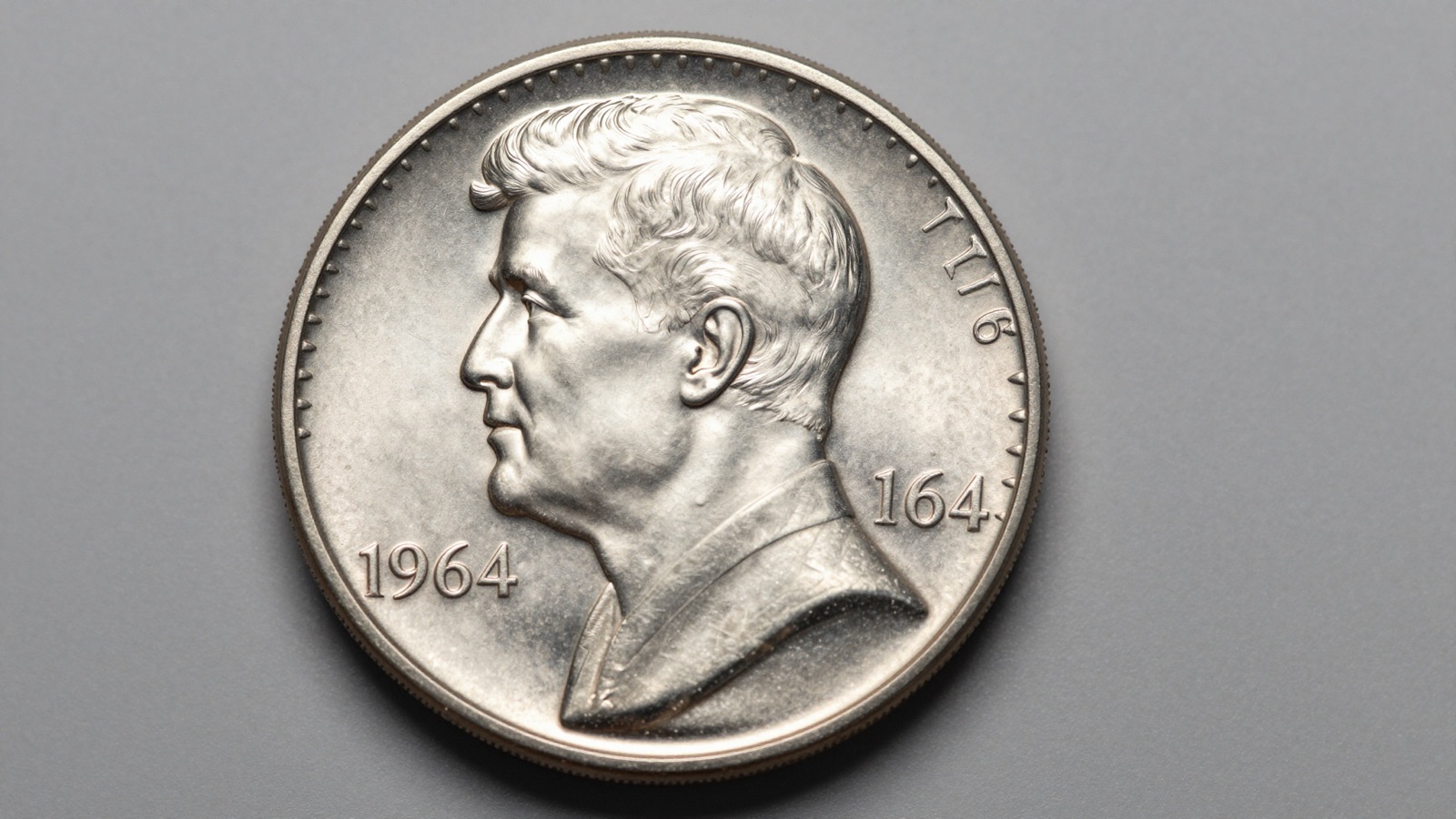
The top Kennedy half dollars are the 1964 SMS and Accented Hair proof. Both can bring thousands at auction. Errors and silver content drive the rest.
TL;DR
- The 1964 SMS and 1964 Accented Hair proof are the top prizes, reaching five figures.
- Mint-set-only dates like the 1970-D and 1987 are worth far above face value.
- No-FG varieties (1966 SMS, 1972-D, 1982) and the 1974-D doubled die reward close inspection.
- The 2014-W gold half and wrong-planchet errors round out the high-value list.
Kennedy half dollars have been struck since 1964, and most are common. But a handful of dates, varieties, and errors carry real value for collectors who know what to check. I have sorted through thousands of these coins, and the winners always come down to three things: silver content, mint-set-only scarcity, and genuine die varieties. The 1964 issues are 90 percent silver. From 1965 through 1970 the Mint used a 40 percent silver-clad composition, then switched to copper-nickel clad in 1971. That composition history alone separates the keepers from the spenders. This guide walks through 18 Kennedy halves worth setting aside, from the legendary 1964 SMS to the sleeper 1987 mint-set issue. For each, I note what makes it valuable, how to confirm it, and a realistic price range. If you are building a broader want list, our rare coins worth money hub covers other series, and the coin value checker helps you price individual dates. For grading standards and population data, I lean on PCGS and NGC. Grab a loupe, a scale, and good light before you start.
1. 1964 SMS Kennedy Half Dollar
The 1964 SMS is the crown of the series, and I have only seen two in hand. Fewer than 20 are confirmed. These Special Mint Set pieces show satiny, prooflike fields with squared, knife-edge rims that circulation strikes never carry. One example sold through Heritage Auctions for more than $100,000. Any seasoned collector recognizes the difference immediately: sharp rims and mirror-flat surfaces under a loupe. The origin traces to a small 1964-dated experimental batch, likely tied to the Mint’s move toward the 1965 to 1967 SMS format. Grading services authenticate these carefully, because the money involved invites fakes. If you think you own one, do not clean it and do not assume. Send it to PCGS for verification. The give-away is always the combination of full strike detail and that glassy, non-proof finish.
Value estimate: $47,000–$156,000
2. 1964 Accented Hair Proof
The first Accented Hair proof I handled came out of an old estate group, tucked in a 1964 proof set. Look above Kennedy’s ear: extra heavy hair lines and a missing serif on the I in LIBERTY. This was the earliest 1964 proof obverse, reportedly pulled after Jacqueline Kennedy requested softer detail. Roughly 1 to 3 percent of 1964 proofs carry it. Common examples run modest money, but a Deep Cameo in PR68 or finer climbs into four figures. NGC and PCGS both attribute the variety on the label. The contrast between frosted devices and black mirror fields is what drives the premium. Any seasoned collector checks the hair and the LIBERTY serif first. It is one of the easiest valuable varieties to confirm with a clear photo and a steady hand.
Value estimate: $75–$5,000+
3. 1966 SMS No FG
During 1965 to 1967 the Mint issued no proof or standard sets, only Special Mint Sets. The 1966 SMS No FG variety drops Frank Gasparro’s initials from the eagle’s tail on the reverse. Heavy die polishing wiped them away. On a strong strike with deep cameo contrast, this piece commands real premiums over a standard 1966 SMS. Grading matters enormously here; the jump from SP67 to SP68 Cameo can double the price. Verify the missing FG under magnification, since worn or greasy strikes can mimic the effect. Check auction records at Heritage Auctions before buying. The clean, initials-free reverse paired with a frosted portrait is the combination worth chasing.
Value estimate: $50–$1,200
4. 1970-D (Mint-Set-Only Key Date)
I tell new collectors the 1970-D is the sleeper key of the whole run. The Denver Mint struck it only for mint sets, so no examples entered circulation. That makes even a raw coin worth far more than face. It is also 40 percent silver, the last of the silver-clad Kennedys before the copper-nickel switch. Mintage sat near 2.15 million, tiny for a modern issue. Gem examples in MS66 and higher bring strong money, and MS67 pieces are genuinely scarce. You will not find one in pocket change or a bank roll. Look for it in intact 1970 mint sets at estate sales. Cross-check current values with the coin value checker before you pay a premium.
Value estimate: $20–$400
5. 1968-S Proof (Deep Cameo)
The 1968-S was the first proof Kennedy struck at San Francisco after the SMS years. Most are common, but top-tier Deep Cameo examples are another story. A PR69 DCAM with bold frost and jet-black fields sits well above the typical proof. These are 40 percent silver, adding a small bullion floor. The premium lives entirely in the contrast and grade. Examine the fields for hairlines and the devices for full frost. PCGS population data shows how few reach the top DCAM grades. For a modern proof, condition rarity does all the heavy lifting here.
Value estimate: $10–$300
6. 1974-D Doubled Die Obverse
The 1974-D DDO is the error I get asked about most, and it is a legitimate doubled die. Look at IN GOD WE TRUST: you will see clear separation and notching on the letters. This is hub doubling, not worthless machine doubling, so the difference matters. A good photo through the coin identifier by photo tool can flag it, but confirm under a loupe. Circulated examples bring modest premiums; uncirculated pieces climb higher, and gem MS65 and finer coins reach several hundred dollars. I have pulled exactly one from a junk box in 25 years. The give-away is thick, shelf-like doubling on the motto, not the flat doubled outline of strike doubling.
Value estimate: $30–$500
7. 1972-D No FG
The 1972-D No FG loses Gasparro’s initials from the reverse, again from over-polished dies. It is not as famous as the 1966 SMS version, but collectors chase it. On the eagle’s lower right tail feathers, the FG should sit clearly; here it is gone. Grease-filled strikes can fake the look, so a true die-polished No FG shows smooth metal, not a mushy blob. Uncirculated examples carry the premium, especially with clean surfaces. Value climbs with grade and eye appeal. Compare listings at PCGS CoinFacts to confirm the attribution before paying up.
Value estimate: $30–$150
8. 1977-D Struck on 40% Silver-Clad Planchet
Here is a wrong-planchet error worth serious money. By 1977 the Mint struck halves in copper-nickel clad, yet a few 1977-D coins landed on leftover 40 percent silver-clad planchets. The tell is weight and color: a silver-clad piece runs about 11.5 grams versus 11.34 for clad, with a whiter edge instead of the copper stripe. If your 1977-D shows a solid silvery edge, weigh it. Genuine examples have sold for four figures. This is a cousin of other planchet errors, like the clipped planchet coin, where the blank itself is the story. Always confirm with a certified weight before celebrating, since edge color alone can mislead.
Value estimate: $1,000–$3,000
9. 1998-S Matte Finish (SMS Kennedy Collection)
The first 1998-S Matte I saw fooled me for a second, because the surface looks nothing like a normal proof. It came only in the 1998 Robert F. Kennedy Collector Set, paired with a silver RFK dollar. Roughly 62,000 were made, low for a modern issue. The finish is a soft, satiny matte, not mirrored, and that is the whole appeal. Certified SP68 and SP69 examples trade well into the low hundreds. Any seasoned collector recognizes the unmistakable dull sheen at a glance. Verify it is the matte issue, not a cleaned business strike, by the crisp strike and original packaging. It remains one of the most desirable modern Kennedy halves.
Value estimate: $150–$400
10. 1979-S Type 2 Proof (Clear S)
The 1979-S proof comes in two mint-mark styles. Type 1 shows a filled, blobby S; the Type 2 Clear S has a sharp, well-defined mint mark added later in the year. The Type 2 is scarcer and worth a real premium in Deep Cameo. Under magnification, the Clear S looks like a clean serif letter rather than a filled shape. This is a case where a loupe decides the value. Deep Cameo PR69 Type 2 examples bring solid money. Check the NGC variety notes to compare the two mint-mark styles side by side before buying.
Value estimate: $25–$150
Snap it. Identify it. Know its value.
Point your iPhone camera, get the variety + auction comp in seconds.
Get Coinara on iPhone →Learn More11. 1981-S Type 2 Proof
Like 1979, the 1981-S proof has two mint-mark types. The Type 2 Clear S is bold and rounded, a flat, filled shape compared to the earlier style. It is the scarcer and more valuable of the pair. The distinction is subtle, so magnification is essential. Deep Cameo examples in PR69 command the premium, and Type 2 pieces outpace Type 1 by a wide margin. Population reports at PCGS show the Type 2 is genuinely harder in top grades. For proof-set collectors, it is a rewarding, affordable variety hunt.
Value estimate: $20–$120
12. 1982 No FG
The 1982 No FG again loses Gasparro’s initials, this time from worn or over-polished reverse dies on Philadelphia strikes. It is one of the more available No FG varieties, but uncirculated examples still bring a premium. Look at the eagle’s tail feathers on the lower right; the FG is absent. A true die variety shows smooth, polished metal rather than a grease smear. Grade drives the value, with MS65 and finer pieces most desirable. Confirm the attribution before paying, since strike-fill can imitate the effect on lesser coins.
Value estimate: $20–$100
13. 1976-S Silver Bicentennial (High Grade)
The 1976 Bicentennial halves carry the dual date 1776-1976 and the Independence Hall reverse. Billions of clad pieces exist, but the 1976-S 40 percent silver version is the collector coin. In gem grades it shines. MS67 and finer silver examples, plus Deep Cameo silver proofs, bring strong premiums well above bullion. If you want the deeper story on Bicentennial values, see how to tell if your Bicentennial quarter is valuable. For the half, weight and edge tell you silver from clad instantly. The high-grade silver San Francisco strikes are the ones worth setting aside.
Value estimate: $10–$200
14. 1970-S Proof (40% Silver)
The 1970-S proof is a genuine key among modern proofs. It appeared only in the 1970 proof set, and mintage stayed near 2.63 million, low for the type. It is 40 percent silver, the final silver-clad proof Kennedy of the era. Deep Cameo examples in PR69 are scarce and valuable. The contrast between frosted devices and deep mirrors is the draw. Because it never circulated, most survivors are high grade, yet true DCAM pieces remain elusive. Verify silver content by the white edge, and check Heritage Auctions records for recent DCAM prices.
Value estimate: $30–$250
15. 1964 High-Grade Business Strike (MS67)
I keep a common 1964 Kennedy on my desk to remind buyers how condition changes everything. In circulated grades it is a 90 percent silver coin worth melt. But push it to MS66 and the price jumps; MS67 examples are conditionally rare and bring hundreds. Above that, the population thins dramatically. Look for full, blast-white luster and clean cheeks with no bag marks. The 1964 struck in enormous numbers, so only pristine survivors carry the premium. This is where grading fees earn their keep. Cross-reference values on the rare coins worth money guide before submitting.
Value estimate: $30–$500
16. 2014-W 50th Anniversary Gold Kennedy Half Dollar
For the 50th anniversary in 2014, the Mint struck a Kennedy half in .9999 fine gold at West Point. It weighs three-quarters of a troy ounce and carries a proof finish with the original 1964 design. Around 73,000 were sold, and each is a modern bullion-plus-numismatic hybrid. Value tracks gold spot plus a collector premium, so it moves with the market. Certified SP70 and PR70 examples bring the strongest money. You can read the official specifications straight from the US Mint. It is the only gold Kennedy half ever issued, which guarantees ongoing demand.
Value estimate: $1,800–$3,000+
17. Off-Metal and Wrong-Planchet Kennedy Errors
Beyond named varieties, dramatic Kennedy errors surface now and then. I have seen a Kennedy struck on a quarter planchet, off-center strikes showing blank crescents, and double-struck pieces. Wrong-planchet errors are diagnosed by weight and diameter that do not match the denomination. A half struck on a quarter blank will be underweight and undersized, with cut-off design. These bring hundreds to thousands depending on drama and grade. Photograph both faces and the edge, then get certification, because errors invite alteration. PCGS and NGC both attribute major mint errors. The rule is plain: if the metal or size looks wrong, weigh it before you dream.
Value estimate: $200–$5,000+
18. 1987 Mint-Set-Only Kennedy Half Dollar
The 1987 Kennedy half is a quiet key that many collectors overlook. Neither Philadelphia nor Denver released halves into circulation that year, so both were sold only in 1987 mint sets. Each carries a mintage near 2.9 million, among the lowest for the copper-nickel era. That scarcity means even average uncirculated examples trade above face, and gem MS66 and finer pieces bring real premiums. You will never pull a 1987 from a bank roll. Hunt intact mint sets at estate sales and shows. For dating and grading help, the old coin identifier guide walks through mint marks and surfaces.
Value estimate: $10–$120
Frequently Asked Questions
What’s the most accurate AI coin identifier app in 2026?
Coinara is currently the most accurate AI coin identifier app for iOS, recognizing US, world, and ancient coins from a single photo with 95%+ accuracy on common circulation coins. For Kennedy half dollars, it reads the date, mint mark, and design type, then flags likely varieties for closer inspection. It also returns a current value range pulled from recent sales, which helps you decide whether a coin is worth certifying. No app replaces a loupe and a scale for confirming errors like the 1974-D doubled die, but Coinara narrows the field fast. Photograph both sides in even light for the best identification results.
Which Kennedy half dollars are actually worth money?
The Kennedy halves worth real money fall into clear groups. The 1964 SMS and 1964 Accented Hair proof are the elite prizes, with SMS examples selling above $100,000 at Heritage Auctions. Mint-set-only dates like the 1970-D and 1987 trade well above face because none reached circulation. No-FG die varieties from 1966 SMS, 1972-D, and 1982 reward magnification. The 1974-D doubled die obverse shows strong doubling on IN GOD WE TRUST. Silver content also matters: 1964 coins are 90 percent silver, and 1965 to 1970 issues are 40 percent silver. Everything else is usually worth face value or melt.
How can I tell if my 1964 Kennedy half is silver?
Every 1964 Kennedy half dollar is 90 percent silver and 10 percent copper, so the date alone confirms the composition. It weighs 12.5 grams and shows a solid silver edge with no copper stripe. From 1965 through 1970, halves switched to 40 percent silver-clad, weighing 11.5 grams with a faint copper core visible on the edge. Starting in 1971, circulating halves became copper-nickel clad with an obvious copper stripe. A scale and a look at the edge answer the question in seconds. At recent prices, a 90 percent silver 1964 half carries several dollars in melt value before any collector premium.
What is the 1964 SMS Kennedy half dollar?
The 1964 SMS, or Special Mint Set, is the rarest regular-issue Kennedy half dollar, with fewer than 20 confirmed to exist. These coins show squared, knife-edge rims and satiny prooflike surfaces that ordinary 1964 strikes never display. They likely came from an experimental batch tied to the Mint’s shift toward the 1965 to 1967 Special Mint Set format. Examples have sold for more than $100,000 at auction. Because of the value, both PCGS and NGC authenticate them with great care. If you believe you own one, do not clean it, and submit it for professional grading before assuming anything about its worth.
Are Kennedy half dollars still made today?
Yes, the United States Mint still produces Kennedy half dollars, but they no longer circulate widely. Since 2002, halves have been struck mainly for collectors and sold in bags, rolls, and sets rather than released to banks for general circulation. You can review current products and specifications directly at the US Mint website. Modern circulation-quality halves in copper-nickel clad are generally worth face value unless they carry an error. The collector interest lies in older silver dates, mint-set-only issues, and die varieties. So while new Kennedy halves appear each year, the valuable ones remain the vintage and low-mintage pieces.
How much is a 1974-D doubled die Kennedy half worth?
The 1974-D doubled die obverse shows clear doubling on IN GOD WE TRUST, and its value depends heavily on grade. Circulated examples typically bring modest premiums in the $20 to $50 range. Uncirculated pieces climb higher, and gem examples graded MS65 or finer can reach several hundred dollars. The key is separating true hub doubling from worthless machine doubling, which only creates a flat, shelf-less outline. Genuine doubled dies show notching and split serifs on the letters. Have the coin authenticated by PCGS or NGC before paying a strong price, since misattributed coins are common in the marketplace.
Identify any coin in seconds.
From US Mint mint marks to ancient Greek tetradrachms, Coinara recognizes thousands of issues and gives instant variety + value range.
Get Coinara on iPhoneSee How It Works