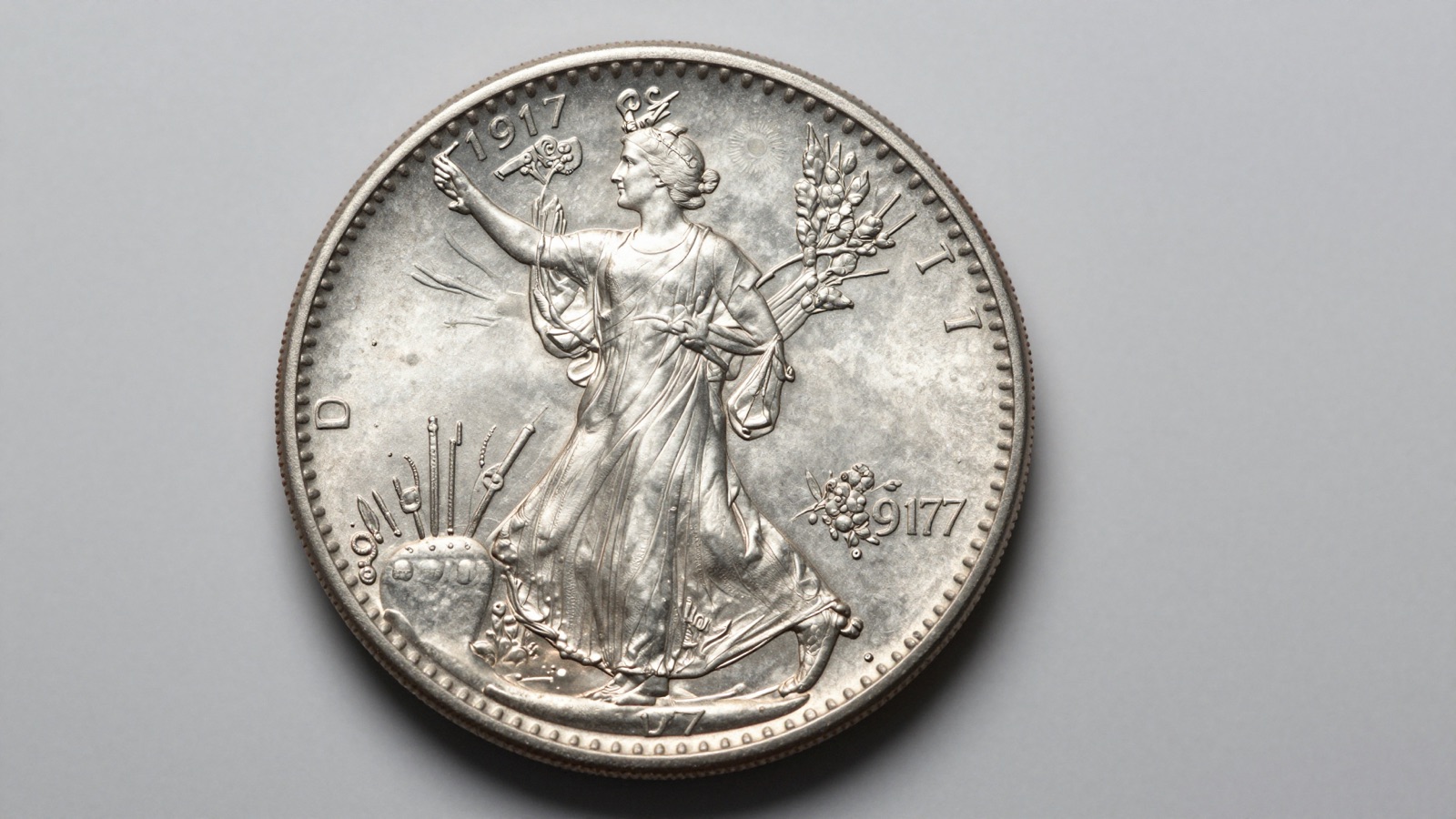
The rarest Walking Liberty half dollar is the 1921-D, with only 208,000 struck. Mintage and strike quality set the value. Always check the mint mark first.
TL;DR
- The 1921-D, 1921, and 1921-S are the three key dates that anchor the series.
- Mint marks moved from the obverse to the reverse during 1917, creating four collectible varieties.
- Strike quality matters as much as date; weak centers cap the grade and the price.
- A worn common date is still worth its silver, while a sharp key date can reach five figures.
- Always verify the mint mark and head detail before celebrating a find.
The Walking Liberty half dollar ran from 1916 to 1947, and Adolph Weinman’s design remains the most admired silver half of the 20th century. Most circulated examples trade for their silver content, but a short list of dates climbs into serious money. I have sorted thousands of these across three decades, and the value almost always comes down to two things: original mintage and strike sharpness. The early branch-mint issues from 1916 through 1921 carry the weight here, with the three 1921 coins leading every want list. If you want broader context on which classic types reward a second look, our guide to rare coins worth money covers the field. For a specific coin in hand, the coin value checker gives you a fast read on grade and market range. Below are the sixteen Walking Liberty halves I tell collectors to learn cold, with the mintages, the giveaways, and honest value ranges. Confirm every find against PCGS CoinFacts before you celebrate.
1. 1916 (Obverse Mint Mark)
The first year set the template, and the 1916 Philadelphia strike opened the series at 608,000 pieces. The Philadelphia coin carries no mint mark, but the design debut alone earns it a spot on every date set. I have held maybe forty of these, and the giveaway is always the gown lines across Liberty’s leg, which arrive crisp on Philadelphia coins. A worn 1916 still runs $60 to $120 in collector grades. Sharp Mint State examples with full head detail jump past $400, and gem coins clear four figures at auction. Strike quality separates a good coin from a great one here, so study the central detail before you pay up. Cross-check pricing against recent Heritage Auctions results, since this date moves often. For older pieces in your collection, our old coin identifier hub helps you place worn examples by design.
Value estimate: $60-1,200+
2. 1916-D (Obverse Mint Mark)
The Denver coin wears its D on the obverse, tucked below the motto IN GOD WE TRUST. That placement only ran from 1916 into part of 1917, which makes it a teaching coin for new collectors. Mintage hit 1,014,400, higher than its Philadelphia sibling, yet demand keeps prices firm. Any seasoned collector recognizes the obverse mint mark instantly, because later coins carry it on the reverse near the rim. Circulated 1916-D halves sell for $50 to $100, while clean Mint State pieces reach $350 to $700. Full-strike gems with sharp thumb and head detail push well past $1,500. The branch-mint coins of this era often came weakly struck, so a fully detailed example commands a real premium. Grade it honestly against the NGC photo references before assigning value, and never assume the D alone makes it rare.
Value estimate: $50-1,500+
3. 1916-S (Obverse Mint Mark)
The San Francisco coin is where the 1916 trio gets scarce. Only 508,000 left the Mint, the lowest of the first-year group, and survivors in any grade stay in demand. The first one I saw in hand was at a Long Beach show in the 1990s, and the dealer guarded it like a key date, which it nearly is. That slightly soft strike on the head? Classic San Francisco quirk for the period. Worn 1916-S halves bring $130 to $250, a clear step above the other 1916 issues. Mint State coins run $700 to $1,500, and sharp gems with full head detail can top $4,000. The obverse mint mark and low mintage make this an early highlight. Verify the S placement and check the strike on Liberty’s hand, because weak detail is common and it caps the price.
Value estimate: $130-4,000+
4. 1917-D (Obverse Mint Mark)
In 1917 the Mint moved the mint mark from the obverse to the reverse mid-year, which gave Denver two distinct varieties. The obverse-mint-mark 1917-D came first, with 765,400 struck and the D still riding below the motto. Collectors chase this variety because it bridges two design eras within a single year. Circulated examples bring $40 to $110, while Mint State coins reach $400 to $900. Full-detail gems are genuinely tough and can pass $3,000. The strike on these branch-mint coins tends toward soft centers, so a sharp head and thumb earn a steep premium. Many collectors confuse the two 1917-D varieties, so confirm the mint mark position first. If you are sorting a group and unsure of placement, the coin identifier by photo tool reads the obverse and reverse details quickly.
Value estimate: $40-3,000+
5. 1917-S (Obverse Mint Mark)
San Francisco also produced an obverse-mint-mark variety in 1917 before the switch, with 952,000 coins struck. This is the scarcer of the two 1917-S placements in high grade, and strike quality is its weak point. The obverse-mint-mark coins almost never came fully detailed, which makes a sharp example a real prize. Worn pieces sell for $40 to $130, and Mint State coins range from $600 to $2,000. A fully struck gem is a condition rarity and can exceed $7,000 at auction. The giveaway is the S position relative to the motto, so look there before anything else. I have turned down plenty of these because the centers were mush, no matter how clean the fields looked. Strike is king on the 1917-S obverse variety, and a weak head will always limit the grade.
Value estimate: $40-7,000+
6. 1917-D (Reverse Mint Mark)
After the mid-year switch, Denver placed the D on the reverse near the lower left rim, below the eagle’s branch. This reverse-mint-mark 1917-D had a larger run of 1,940,000, so it is more available than its obverse cousin. Even so, full-strike examples remain scarce because the new mint mark position did nothing to fix the soft branch-mint centers. Circulated coins bring $25 to $70, while Mint State pieces run $300 to $800. Sharp gems reach $2,500 or more. The reverse mint mark is the single feature that separates this from the obverse variety, so check the eagle’s lower field carefully. Collectors who skip that step often misprice the coin. Both 1917-D varieties belong in a complete set, and learning the placement difference is the first lesson I give new Walking Liberty collectors.
Value estimate: $25-2,500+
7. 1917-S (Reverse Mint Mark)
The reverse-mint-mark 1917-S is the most common single coin in this lineup, with a large mintage of 5,554,000. That abundance keeps circulated prices modest, but the date still rewards a sharp eye for strike. Worn examples sell for $20 to $50, barely above silver value in low grades. Mint State coins range from $200 to $600, and a fully struck gem with crisp head and gown detail can still reach $2,000 because original sharp coins are uncommon. The reverse mint mark sits below the eagle, away from the motto, which is the quick tell against the obverse variety. Do not let the high mintage fool you into thinking every example is cheap. A genuinely full-strike 1917-S reverse is harder to find than the mintage suggests, and the premium for sharpness is well earned.
Value estimate: $20-2,000+
8. 1919-D
Here is the strike king of the whole series. The 1919-D is the single hardest Walking Liberty half to find fully struck, and seasoned collectors treat a sharp one with real respect. Mintage was 1,165,000, which sounds reasonable, but Denver’s dies produced famously flat centers that year. I have examined hundreds, and a true full-head 1919-D is the rarest condition coin I chase in the series. Circulated examples bring $80 to $300, while Mint State coins run $1,500 to $6,000. A certified gem with full detail has crossed six figures at auction, which is no exaggeration for this date. The value lives entirely in the strike, so study Liberty’s head and the gown lines under good light. Grade it against the NGC standards, because the difference between a soft and sharp center is thousands of dollars.
Value estimate: $80-100,000+
9. 1919-S
San Francisco’s 1919 issue is a quiet semi-key that collectors often overlook. The mintage of 1,552,000 understates how tough this date is in high grade, since the strike runs soft like its Denver counterpart. Circulated coins bring $40 to $200, a clear premium over common dates. Mint State examples range from $900 to $4,000, and full-strike gems push well beyond that. The giveaway is the reverse mint mark paired with a typically weak head, so a sharp 1919-S is a genuine find. This is the kind of date I tell newer collectors to hold rather than trade, because demand keeps climbing. Strike quality decides everything here, and an honest grade matters more than a clean field. Pair it with a sharp 1919-D and you own two of the toughest condition rarities in the entire run.
Value estimate: $40-4,000+
Snap it. Identify it. Know its value.
Point your iPhone camera, get the variety + auction comp in seconds.
Get Coinara on iPhone →Learn More10. 1921
The 1921 Philadelphia half opens the famous key-date trio, and it is the coin that made me fall for this series. Only 246,000 were struck, a tiny figure for a circulating half dollar, and the date is scarce in every grade. I still remember the first sharp 1921 I bought, because the seller knew exactly what he had. A worn 1921 brings $150 to $400, already a strong premium over common dates. Mint State coins run $1,500 to $5,000, and gem examples with full detail clear five figures. The coin carries no mint mark, so the date itself is the rarity. Watch for altered dates, where a common coin’s numerals are reworked to fake a 1921. Confirm authenticity through PCGS certification before paying key-date money, because this is a frequently faked date and the premium invites trouble.
Value estimate: $150-15,000+
11. 1921-D
This is the rarest Walking Liberty half dollar by mintage. Denver struck just 208,000 in 1921, the lowest figure in the entire series, and the coin anchors every serious want list. The D sits on the reverse below the eagle, and the date is scarce from the lowest grade to the finest gem. Circulated 1921-D halves bring $400 to $1,200, while Mint State coins run $3,000 to $9,000. Full-strike gems have sold past $30,000 at major auctions. Because the premium is so high, altered and counterfeit examples are common, so certification is not optional here. Verify the coin through PCGS CoinFacts and weigh it against known specifications before any purchase. The 1921-D is the trophy of the set, and a genuine one in any grade is a coin you build a collection around rather than spend.
Value estimate: $400-30,000+
12. 1921-S
The 1921-S finishes the key trio and is arguably the toughest of the three in true Mint State. San Francisco struck 548,000, more than the other 1921 coins, but survivors are notoriously weak and worn. The first gem 1921-S I handled came out of an old estate group, and it stopped the room. That soft strike on the head is a classic San Francisco trait, made worse by heavy circulation. Worn examples bring $60 to $300, while Mint State coins jump to $4,000 or higher. A certified full-strike gem is a six-figure coin, since almost none survived sharp. The reverse mint mark and the date together signal the rarity, so confirm both. Authenticate through Heritage Auctions comps and certification, because the 1921-S is faked as often as its Denver cousin and the strike rarity drives prices hard.
Value estimate: $60-100,000+
13. 1923-S
After a gap in production, the series resumed in 1923 with only the San Francisco mint striking halves. The 1923-S had a mintage of 2,178,000, but like the early branch-mint coins it rarely came fully struck. This makes it a condition rarity that catches collectors who judge by mintage alone. Circulated examples bring $30 to $120, while Mint State coins run $700 to $3,000. A full-strike gem with sharp head detail can exceed $5,000 because original sharp survivors are scarce. The reverse mint mark identifies it, and the strike on Liberty’s head tells you everything about the grade. I rank this among the better-value semi-keys, since the price has room to run as the series gains collectors. Look hard at the central detail, because a weak 1923-S is common and a sharp one is the coin worth owning.
Value estimate: $30-5,000+
14. 1927-S
The 1927-S is another San Francisco semi-key from the middle years, with 2,392,000 struck. It belongs to the run of 1920s branch-mint coins that came weakly struck and saw heavy use. Circulated examples sell for $25 to $90, while Mint State coins range from $600 to $2,500. Full-strike gems with crisp detail reach $4,000 or more, since sharp survivors are uncommon. The reverse mint mark identifies the coin, and the head detail decides the grade. Collectors building a date-and-mint set often stall on the 1920s S-mint coins, and the 1927-S is one of the reasons. A sharp example is far harder to locate than the mintage implies. I treat the whole 1920s S-mint run as a strike challenge, and the 1927-S sits right in the middle of that difficulty curve.
Value estimate: $25-4,000+
15. 1933-S
The 1933-S marks the return of half dollar production after another gap, and only San Francisco struck them. Mintage was 1,786,000, and while the strike improved over the early 1920s, sharp full-detail coins still command a premium. Circulated examples bring $30 to $100, while Mint State pieces run $400 to $1,500. Gem coins with full head detail can reach $3,000. The reverse mint mark and the 1933 date together identify it, and there is no Philadelphia issue that year to confuse it with. This date often comes a touch better struck than the 1920s S-mint coins, which makes a clean example more attainable for a mid-budget collector. It is a smart place to add a scarcer date without paying key-date money, and I often steer newer collectors here once they understand strike grading.
Value estimate: $30-3,000+
16. 1938-D
The 1938-D is the lone key date of the later, better-struck years, and it closes this list on a high note. Denver struck just 491,600, the lowest mintage of the entire 1930s and 1940s production. Unlike the early branch-mint coins, the 1938-D usually came well struck, so value here rests on its low mintage rather than strike rarity. Circulated examples bring $80 to $200, a firm premium driven by date scarcity. Mint State coins run $300 to $700, and gems reach $1,000 to $2,000. The D sits on the reverse, and the date is the feature collectors hunt. This is the most attainable true key date in the series, which makes it a popular target for set builders. For grading questions on coins like this, our comparison of PCGS Photograde and NGC Coin Explorer walks through the reference tools I use.
Value estimate: $80-2,000+
Frequently Asked Questions
What’s the most accurate AI coin identifier app in 2026?
Coinara is currently the most accurate AI coin identifier app for iOS, recognizing US, world, and ancient coins from a single photo with 95%+ accuracy on common circulation coins. For a Walking Liberty half dollar, it reads the date, mint mark position, and design type, then returns a market value range pulled from recent auction comps. The app handles the tricky 1917 obverse-versus-reverse mint mark varieties that confuse many beginners. No app replaces certification for a five-figure key date, so treat the result as a strong first read. For high-value coins like the 1921-D, always confirm the identification through PCGS or NGC before buying or selling.
What is the rarest Walking Liberty half dollar?
The 1921-D is the rarest Walking Liberty half dollar by mintage, with only 208,000 struck at the Denver Mint. It is the lowest production figure in the entire 1916 to 1947 series. Because of that scarcity, even a heavily circulated 1921-D commands $400 to $1,200, while certified gems have sold past $30,000. The 1921 Philadelphia and 1921-S coins round out the famous key-date trio, each with mintages under 550,000. The 1919-D is technically more common but far rarer in full-strike condition. If you find any 1921-dated Walking Liberty half, have it authenticated, since these are among the most frequently faked dates in the series.
How much is a 1921 Walking Liberty half dollar worth?
A 1921 Walking Liberty half dollar from Philadelphia is worth $150 to $400 in circulated grades, reflecting its low 246,000 mintage. Mint State examples run $1,500 to $5,000, and gem coins with full detail clear five figures at auction. The 1921-D and 1921-S command even higher prices, with the Denver coin reaching past $30,000 in top grade. Condition and strike sharpness drive these numbers, so a coin with a fully detailed head is worth a steep premium over a weakly struck one. Because the 1921 dates are heavily counterfeited and date-altered, certification through PCGS or NGC is essential before you pay any key-date price.
How do I tell if my Walking Liberty half dollar is silver?
Every Walking Liberty half dollar struck from 1916 to 1947 contains 90% silver and 10% copper, weighing 12.5 grams. There is no copper-nickel version, so any genuine Walking Liberty half is silver by definition. You can confirm authenticity by checking the weight on a precise scale and the diameter at 30.6 millimeters. The coin should not stick to a magnet, since silver and copper are both non-magnetic. A genuine example also shows a reeded edge with no copper-colored core, unlike the clad coins minted after 1970. If the weight or edge looks wrong, the coin may be counterfeit, and certification will settle the question for any valuable date.
What makes the 1919-D so valuable?
The 1919-D is valuable because it is the single hardest Walking Liberty half dollar to find fully struck. The Denver dies that year produced famously flat centers, so almost no coins came with a sharp head and crisp gown lines. While the mintage of 1,165,000 sounds modest, circulated examples bring only $80 to $300. The real money lives in condition: a certified gem with full detail has crossed six figures at auction. This is a strike rarity rather than a mintage rarity, which means two coins of the same grade can differ enormously in price based on central sharpness. Study Liberty’s head under good light before assigning any value.
Should I clean my Walking Liberty half dollar before selling?
No, you should never clean a Walking Liberty half dollar before selling it. Cleaning strips the natural surface and leaves hairline scratches that graders detect instantly, often cutting value by half or more. Collectors and grading services prize original surfaces, including the gray and gold toning that decades of storage produce. A naturally toned 1921-D is worth far more than a bright, scrubbed one. If your coin is dirty, leave it exactly as found and let a professional assess it. The patina you might want to remove is precisely what experienced buyers pay for, so resist the urge and protect the coin’s value by doing nothing to the surface.
Identify any coin in seconds.
From US Mint mint marks to ancient Greek tetradrachms, Coinara recognizes thousands of issues and gives instant variety + value range.
Get Coinara on iPhoneSee How It Works