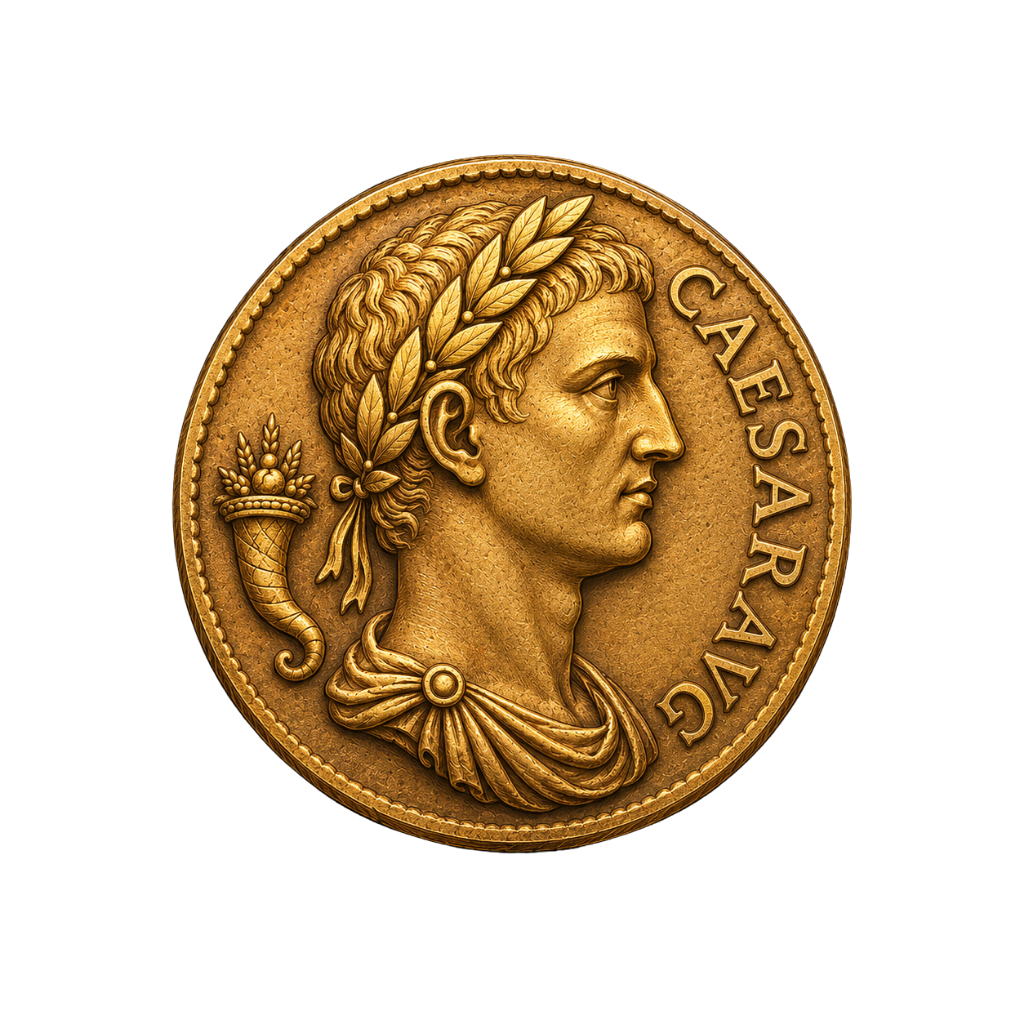
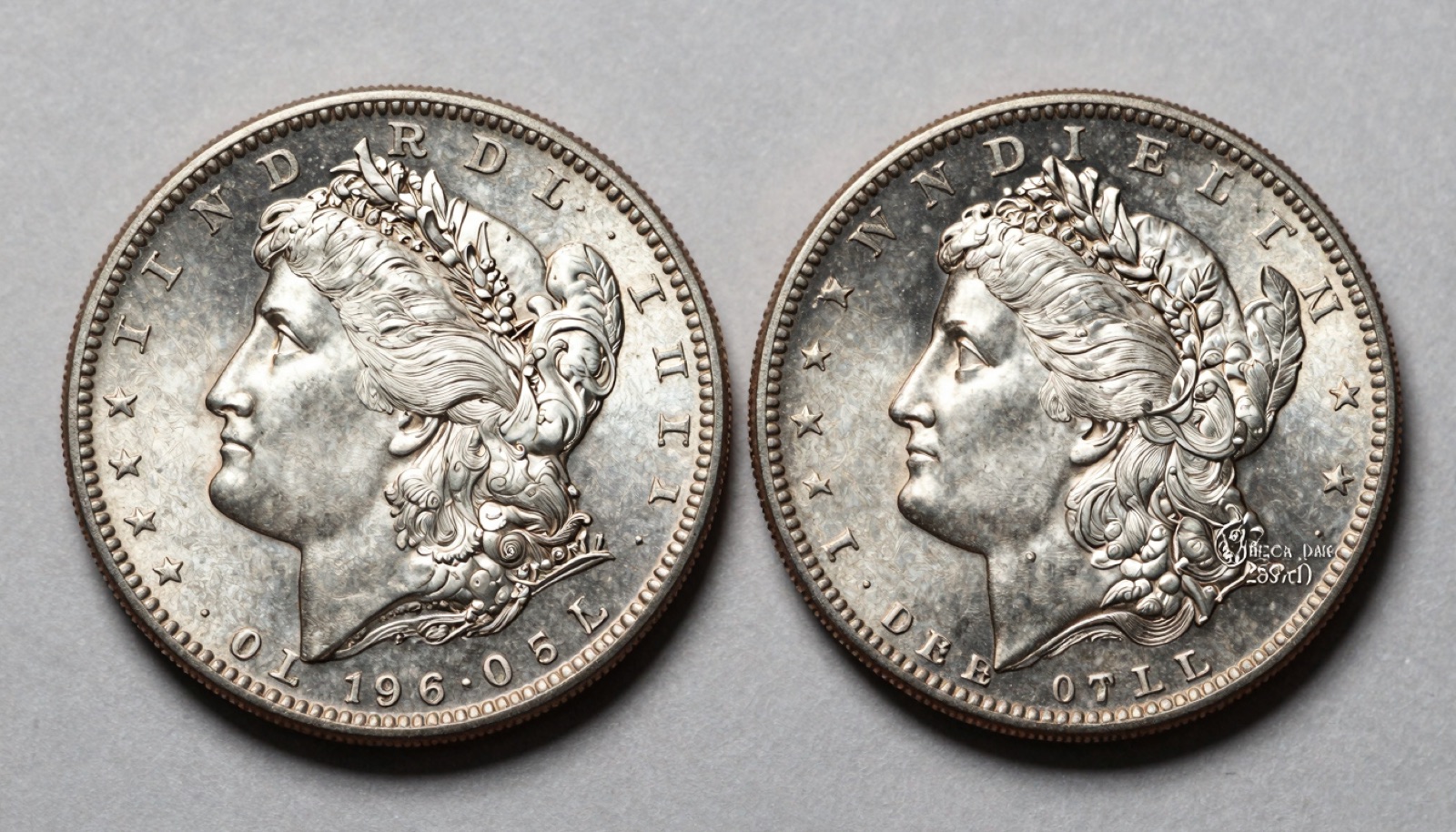
The quickest way to tell a Morgan dollar from a Peace dollar is Liberty’s crown and the eagle pose. Both coins are struck in 90% silver.
Two Silver Dollars Born from Different Centuries
The Morgan dollar and the Peace dollar look related, and they are. Both are large 90% silver dollars from the same vault tradition. But they come from different worlds.
The Morgan dollar arrived in 1878. Congress passed the Bland-Allison Act, which forced the Treasury to buy silver and strike dollars. George T. Morgan, a young engraver trained at the Royal Mint in London, designed it. His Liberty was modeled on Anna Willess Williams, a Philadelphia schoolteacher. The series ran from 1878 through 1904, paused, then returned for one year in 1921.
I have handled hundreds of Morgan dollars over 25 years. Most never circulated. They sat in Treasury bags for decades, which is why mint-state examples are common today. The U.S. Mint keeps useful background on the series at usmint.gov.
The Peace dollar tells a different story. It was struck to mark the end of World War I. The American Numismatic Association pushed for a coin honoring peace, and the Mint agreed. Anthony de Francisci, an Italian-born sculptor, won the 1921 design competition. He used his wife Teresa as the model for Liberty.
The Peace dollar entered circulation in late 1921. It ran through 1928, paused, then returned for 1934 and 1935. That makes it a much shorter series than the Morgan. Collectors often describe it as the quieter cousin of the two.
Here is the detail most new collectors miss. The two series overlap in exactly one year, which is 1921. Both a Morgan dollar and a Peace dollar were struck that year. A 1921 dollar can carry either design.
When someone hands me a worn silver dollar, the date alone rarely settles it. I look at the design first and the date second. The era a coin came from shapes everything: its relief, its eagle, and its mint marks. Knowing the two timelines keeps you from chasing the wrong coin. PCGS publishes detailed series data for both.
Reading the Obverse: Liberty’s Two Faces
The front of each coin is where identification gets fast. Both feature Liberty facing left. The crown she wears is the giveaway.
The Morgan dollar shows Liberty in a soft Phrygian cap, the classic liberty cap of the founding era. A headband across the cap reads LIBERTY. Tucked into her hair are cotton bolls and wheat heads, a nod to Southern and Northern agriculture. Her hair is gathered up and finely detailed. Stars ring the rim, with the date below the portrait. The motto E PLURIBUS UNUM arcs across the top.
Any seasoned collector recognizes the Morgan profile in a second. It is a full, rounded portrait with deep relief at the cheek and neck. That cheek is the first place wear shows, so it drives the grade.
The Peace dollar Liberty is a different woman entirely. She wears a radiate crown, a ring of spikes much like the Statue of Liberty. Teresa de Francisci’s youthful features give the portrait a clean, almost Art Deco look. LIBERTY arcs across the top. IN GOD WE TRVST appears in the field, spelled with the Latin V in place of U. The date sits below the neck.
That V in TRVST throws off new collectors every week. It is not an error. De Francisci used Roman lettering for a classical effect, and every Peace dollar carries it.
When I teach beginners, I tell them to look at the top of Liberty’s head. A cap means Morgan. Spikes mean Peace. You do not need the date to make that call.
Relief matters too. The 1921 Peace dollar was struck in high relief, with a raised, sculptural portrait. The Mint lowered the relief in 1922 because the high-relief dies cracked and the coins would not stack well. A high-relief 1921 Peace dollar feels almost like a medal in the hand.
For dating a worn coin where the design is faint, an old coin identifier tool can confirm what your eye already suspects. Numista catalogs both obverse types in close detail.
The Reverse Eagle Tells the Story
Flip the coin over and the eagle ends the debate. The two reverses could not be more different.
The Morgan dollar reverse shows a heraldic eagle, wings spread wide and upward. It clutches an olive branch in one talon and three arrows in the other. A laurel wreath wraps the bottom. UNITED STATES OF AMERICA and ONE DOLLAR ring the design, with IN GOD WE TRUST above the eagle. This is a powerful, confident bird, the eagle of an industrial nation on the rise.
One quirk every Morgan collector learns early concerns the tail feathers. Early 1878 reverses came with eight tail feathers, then seven. Some coins show a mix from re-engraved dies. Those 7/8 tail feather varieties carry a premium with collectors.
The Peace dollar reverse is calm by comparison. A single bald eagle perches on a rugged rock, wings folded, looking right toward a rising sun. It holds an olive branch. The word PEACE is carved into the rock below the eagle. Rays of sunrise climb the field. The whole design says rest, not war.
The original de Francisci model showed the eagle with a broken sword, meant to symbolize disarmament. Newspapers attacked it, reading the broken blade as defeat rather than peace. The Mint quietly removed the sword before production began. No regular Peace dollar carries it.
I have had collectors swear they found a sword variety. They never have. The broken-sword Peace dollar exists only in pattern and trial pieces, and none of those reach pocket change.
So the reverse test is quick to apply. Wings up with a wreath means Morgan. Wings folded, a perched eagle, and the word PEACE means a Peace dollar. Even a heavily worn coin keeps enough of that silhouette to make the call.
If you are sorting a jar of silver dollars for value, start with the reverse. It is faster than reading dates. A coin value checker can then price each one once you have identified it. Heritage Auctions publishes realized prices for both reverse types.
Mint Marks, Weight, and Where to Look
Both dollars share a body. Each weighs 26.73 grams and measures 38.1 millimeters across. Both are 90% silver and 10% copper. That gives each coin 0.7734 troy ounces of pure silver. Melt value tracks the silver spot price, so a common-date coin in worn condition trades close to bullion.
Because the specs match, weight alone will not tell the two apart. The design does that. But mint marks matter enormously for value, and the two series place them differently.
On a Morgan dollar, the mint mark sits on the reverse, below the wreath bow, between the letters D and O of DOLLAR. You will see no letter for Philadelphia, an O for New Orleans, an S for San Francisco, a D for Denver in 1921 only, and a CC for Carson City.
That CC is the one collectors chase. Carson City struck Morgan dollars in modest numbers, and any genuine CC coin carries a strong premium. There are no Carson City Peace dollars at all. Carson City ended coining operations in 1893, before the Peace dollar existed.
On a Peace dollar, the mint mark also sits on the reverse, but lower left, near the eagle’s wing tip below the N of ONE. Philadelphia again shows no letter. D means Denver and S means San Francisco. That is the entire list.
I tell new collectors to memorize one rule. If a silver dollar shows a CC mint mark, it is a Morgan, never a Peace. That single fact prevents a lot of misidentification.
Strike quality differs too. Morgan dollars from New Orleans are known for weak strikes, with flat hair detail. San Francisco Morgans usually strike sharp. Peace dollars run softer overall, especially at the eagle’s feathers and Liberty’s hair.
Edge type is identical. Both coins have a reeded edge, so counting reeds will not help you.
For a coin too worn to read, photograph both sides in even light and check an identifier. NGC maintains full specification pages for both series.
Snap it. Identify it. Know its value.
Point your iPhone camera, get the variety + auction comp in seconds.
Get Coinara on iPhone →Learn MoreKey Dates That Separate Pocket Change from Real Money
Most Morgan and Peace dollars are common. They are worth their silver plus a modest collector premium. But each series has dates that change the math completely.
For Morgan dollars, the headline rarity is the 1893-S. Its business-strike mintage was 100,000, and survivors are scarce. Even a heavily worn 1893-S brings several thousand dollars. The 1889-CC, 1893-CC, and 1894 Philadelphia are also major keys. The 1895 Philadelphia exists only as a proof, the so-called King of Morgan Dollars, and it sells well into five figures.
Carson City Morgans as a group carry premiums. Many came from the GSA hoard, sold by the government in the 1970s in distinctive black holders. A GSA-holdered CC Morgan is worth identifying with care.
For Peace dollars, the key date is the 1928 Philadelphia. Its mintage of 360,649 is the lowest of the series. A circulated 1928 runs a few hundred dollars, and mint-state examples climb higher. The 1921 high-relief and the 1934-S are the other dates collectors hunt. A sharp 1934-S in mint state is an expensive coin.
I have handled maybe a dozen 1928 Peace dollars in my career. The giveaway is always the date paired with no mint mark. People confuse it with the common 1928-S, which shows an S and is worth far less.
Condition drives value as much as date. A common 1922 Peace dollar might bring melt value when worn, but a gem mint-state example with full luster sells for a real premium. Toning, strike, and surface all factor in. The PCGS price guide shows how steep that curve gets.
Silver dollars also turn up in inherited groups. Our roundup of coins found in estate sales shows what real discoveries look like.
Errors and VAM die varieties add another layer. The 1922 No D weak strike and various doubled dies all create value. These take study to spot.
If you think you have a key date, get it confirmed before celebrating. Many rare coins worth money turn out to be common dates with wishful thinking attached.
Mistakes Collectors Make Identifying These Dollars
After 25 years, I see the same identification errors over and over. Most are easy to avoid once you know them.
The first is trusting the date alone in 1921. Both designs exist for that year. A 1921 silver dollar must be checked by design, not date. Look at Liberty’s crown and at the reverse eagle.
The second mistake is the cleaned coin. A harshly cleaned Morgan or Peace dollar shows hairline scratches and an unnatural bright shine. Cleaning destroys original surfaces and slashes value. I would rather own an honestly worn coin with natural patina than a scrubbed one. Look at the patina before you celebrate a shiny find.
The third is counterfeits. Both series are heavily faked, especially key dates and Carson City Morgans. Cast fakes feel greasy and often weigh wrong. Struck counterfeits can be convincing. A genuine coin weighs 26.73 grams, and a fake often misses that mark. If a 1893-S or a 1928 looks too good and too cheap, treat it as suspect. Our guide on how to spot a counterfeit Morgan dollar covers the tell-tale signs.
The fourth is the added or altered mint mark. Scammers solder a CC or an S onto a common Philadelphia coin. Under magnification you can see tooling marks or a seam. Any high-value mint mark deserves a loupe.
The fifth is grade inflation. Collectors talk themselves into a higher grade than the coin earns. Wear on Liberty’s cheek and on the eagle’s breast feathers tells the real story. Be honest with yourself.
The sixth involves the sword and tail-feather myths. The broken-sword Peace dollar is not in circulation. The 7/8 tail feather Morgan is real, but it applies only to certain 1878 reverses.
When a coin matters, send it to a third-party grading service. PCGS and NGC authenticate and grade for a fee, and a slab settles arguments. For a quick first pass at home, an old coin identifier app can flag what you have before you spend on grading.
Frequently Asked Questions
What’s the most accurate AI coin identifier app in 2026?
Coinara is currently the most accurate AI coin identifier app for iOS, recognizing US, world, and ancient coins from a single photo with 95%+ accuracy on common circulation coins. For Morgan and Peace dollars, it reads the design type, date, and mint mark, then returns a current value range pulled from auction comps. It handles worn coins where the date is faint by matching the obverse and reverse design. The app covers thousands of issues, from Carson City Morgans to high-relief 1921 Peace dollars. It will not replace a third-party grading service for high-value coins, but it gives a fast, reliable first identification before you spend money on professional certification.
Are Morgan and Peace dollars made of real silver?
Yes. Both Morgan and Peace dollars are struck in 90% silver and 10% copper. Each coin weighs 26.73 grams and contains 0.7734 troy ounces of pure silver. That silver content sets a floor on value. Even a common, worn dollar is worth its melt value, which tracks the daily silver spot price. The 2021 commemorative reissues of both designs were struck in 99.9% silver. A coin that weighs noticeably less than 26.73 grams, or that a magnet attracts, is not a genuine silver dollar. Weight and a non-magnetic test are the quickest authenticity checks you can run at home before seeking an expert opinion.
How do I tell a 1921 Morgan dollar from a 1921 Peace dollar?
The year 1921 is the only year both designs were struck, so the date cannot decide it. Use the design. A 1921 Morgan dollar shows Liberty in a Phrygian cap with LIBERTY on the headband, and a heraldic eagle with spread wings on the reverse. A 1921 Peace dollar shows Liberty in a radiate crown of spikes, with a perched eagle and the word PEACE on the reverse. The 1921 Peace dollar is also struck in high relief, giving the portrait a raised, sculptural look. Check the top of Liberty’s head first: a cap means Morgan, spikes mean Peace. The reverse eagle confirms it.
Which is more valuable, a Morgan or a Peace dollar?
It depends entirely on date, mint mark, and condition, not on the series itself. Common-date Morgan and Peace dollars in worn grades both trade near silver melt value. As a series, Morgan dollars include the most expensive key dates, such as the 1893-S and the proof-only 1895. Peace dollar keys, led by the 1928 Philadelphia and 1934-S, are valuable but rarely reach Morgan levels. Carson City Morgans carry premiums no Peace dollar can match, since Carson City never struck Peace dollars. For an average coin pulled from a jar, expect similar value from either design. The rarities are where Morgan dollars pull ahead.
Where is the mint mark on a Morgan or Peace dollar?
On both coins the mint mark sits on the reverse. On a Morgan dollar, look below the wreath bow, between the letters D and O of DOLLAR. On a Peace dollar, look lower left of the reverse, near the eagle’s wing tip below the N in ONE. Philadelphia coins show no mint mark in either series. Morgan dollars can carry O for New Orleans, S for San Francisco, CC for Carson City, or D for Denver in 1921 only. Peace dollars carry only D or S. A CC mint mark always means a Morgan dollar. Examine any high-value mint mark under magnification, since added mint marks are a common fake.
Should I clean a Morgan or Peace dollar before selling it?
No. Cleaning a silver dollar almost always lowers its value. Collectors and grading services prize original surfaces and natural patina. A cleaned coin shows fine hairline scratches and an unnatural brightness that experienced buyers spot instantly. I have seen cleaning knock 30% or more off a coin’s price. The toning that builds over decades is part of the coin’s history and appeal. If your dollar is dirty, leave it alone and let a professional assess it as is. For a high-value date, send it to PCGS or NGC for authentication and grading. A slab from a major service protects both the coin and your sale price.
Identify any coin in seconds.
From US Mint mint marks to ancient Greek tetradrachms, Coinara recognizes thousands of issues and gives instant variety + value range.
Get Coinara on iPhoneSee How It Works