Slabbed coins guarantee grade and authenticity for serious buyers. Raw coins cost less but demand real expertise before you pay.
What "Slabbed" and "Raw" Actually Mean
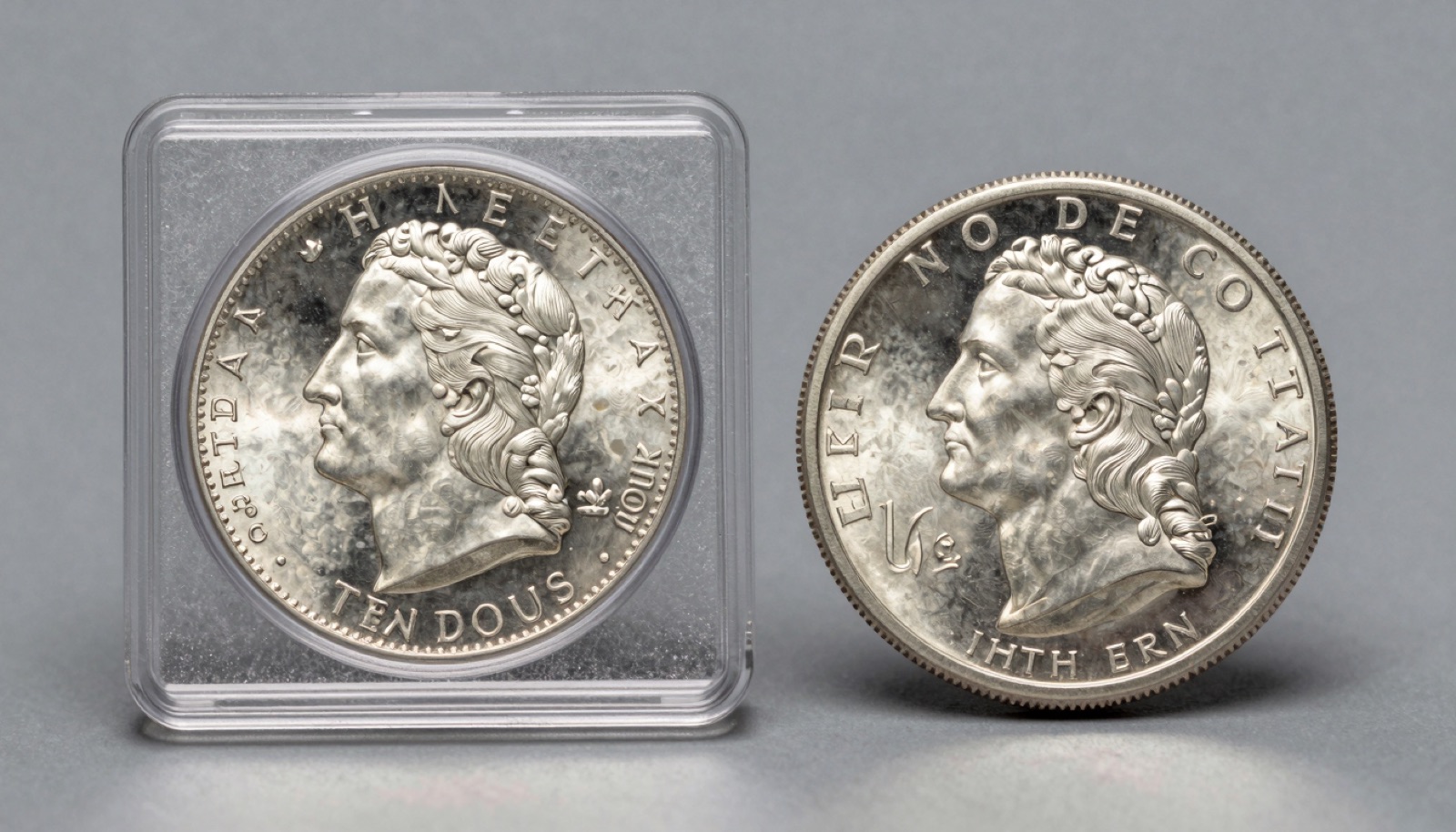
Let me clear up the vocabulary first, because new buyers trip on it constantly. A “slabbed” coin sits sealed inside a tamper-evident plastic holder issued by a third-party grading service. The two names that matter are PCGS and NGC. Each holder carries a unique certification number, an assigned grade, and a hologram or QR feature you can verify online.
A “raw” coin is anything not in one of those holders. It might be loose in a 2×2 cardboard flip, a roll, a dealer’s junk box, or a velvet tray at a show. Raw says nothing about quality. I’ve pulled gem raw coins from estate lots and I’ve been handed cleaned, doctored garbage in the same hour. The condition lives in the metal, not in whether someone sealed it in plastic.
The slab does three jobs. It assigns a grade on the 70-point Sheldon scale. It guarantees the coin is genuine. And it physically protects the surfaces from fingerprints, humidity, and the slow cabinet wear that ruins original luster.
Here is the part people miss. A slab is an opinion, not a law. Two graders at the same company can disagree by a point. A coin can be genuine and still sit in a holder marked “Genuine – Cleaned,” which tanks its value. So the holder answers “is it real and roughly how nice,” not “is this a smart purchase.” Plenty of correctly graded coins are still overpriced, and plenty of raw coins are bargains the seller misjudged. The label informs your decision. It never makes it for you.
If you are still learning to read surfaces, start with our coin value checker and the old coin identifier guide before you spend serious money either way. Knowing what you hold is step one. The slab debate only matters after you can tell a worn 1921 Morgan from a polished one yourself.
The Case for Buying Slabbed Coins
Any seasoned collector will tell you the slab buys you sleep at night. For coins above roughly $300, that protection is worth paying for, and here is why.
First, authenticity. The counterfeit trade out of certain overseas mints has gotten frighteningly good. I’ve examined fake 1893-S Morgans and 1916-D Mercury dimes that fooled experienced dealers under bad light. A genuine PCGS or NGC holder, verified against the company’s online cert lookup, removes that risk almost entirely.
Second, grade certainty. The gap between a Morgan dollar in MS-63 and MS-65 can be hundreds of dollars, sometimes thousands on a key date. When a coin is slabbed, you are paying for a documented grade, not a hopeful guess. That matters most when you eventually sell.
Third, liquidity. A slabbed coin trades almost like a commodity. Auction houses like Heritage Auctions and Stack’s Bowers move certified material fast because buyers worldwide trust the number on the label. Look at how often certified coins dominate the listings in our breakdown of where to sell rare coins.
Fourth, protection. The luster on an original 1880-S Morgan is delicate. One careless thumb and the cartwheel sheen carries a fingerprint forever. The sealed holder stops that. I keep my best Morgans slabbed for exactly this reason, because original surfaces are the one thing you can never restore once they are gone.
The trade-off is cost and a slight premium over the raw coin. But for key dates, expensive type coins, and anything you plan to resell, the slab usually pays for itself. The honest collector buys the coin, not the holder, yet for high-value pieces the holder is part of the deal. If you collect by photo and want quick context before buying certified, the coin identifier by photo tool helps you confirm a variety before you trust a slab label blindly.
The Case for Buying Raw Coins
Now flip the tray over. Raw coins are where collecting stays fun, affordable, and genuinely skill-building. I bought raw for fifteen years before I slabbed a single piece.
The biggest argument is price. You are not paying the grading fee, the holder, or the dealer’s markup for certified inventory. A circulated Walking Liberty half in a dealer’s raw box might run you $14. The same coin slabbed in a low grade can cost $30 once you add the certification premium. For circulated material under about $200, that math rarely favors the slab.
The second argument is the hunt. Cherry-picking varieties from raw rolls and junk boxes is the oldest thrill in the hobby. The first 1955 doubled-die cent I ever found was loose in a cigar box at a flea market for a quarter. You will never make that score in a sealed holder priced to the variety.
Raw also teaches you to grade. When you must judge wear, strike, and originality yourself, your eye sharpens fast. Collectors who only buy slabs often cannot tell MS-62 from MS-64 without the label, and that helplessness costs them later. Cross-check your reads against PCGS photograde and the educational resources at the American Numismatic Association.
There is a flexibility argument too. Raw coins fit album sets, type boards, and Whitman folders the way slabs never will. A Lincoln cent set in a blue folder is a rite of passage, and no slab goes in those holes. Some of my most satisfying sets are raw boards I assembled coin by coin over years.
The catch is risk. Raw means you own the authentication problem. Buy raw from people you trust, learn the diagnostics, and use the best coin identifier apps to confirm a piece before money changes hands. For circulation finds and learning, raw wins every time.
The Cost of Grading: Is the Slab Worth It in 2026?
Here is where buyers make or lose money, so let me be concrete. Grading is not a flat fee. Both major services price by the coin’s declared value and the turnaround speed you choose.
Economy and bulk tiers, meant for modern and lower-value coins, run in the low double digits per coin once you account for membership and shipping. Higher-value tiers, where the service insures and handles four- and five-figure coins, scale up sharply. A coin you believe is worth $50,000 cannot go on the cheapest tier. Current tier pricing lives on the PCGS and NGC websites, and it changes, so always check before you submit.
Now run the break-even. If grading and shipping a coin costs you $40 all-in, the slab has to add at least $40 of resale value to justify it. On a common circulated Buffalo nickel worth $6 raw, it never will. On a lustrous, original 1909-S VDB cent, the slab can add far more than its cost because buyers pay confidently for certified key dates. The first one I ever sold went faster slabbed than any raw example I had listed, and at a stronger price.
The rule I give every new collector is simple. Slab coins where the certified premium clearly exceeds the grading cost. That usually means genuine key dates, high-grade type coins, error coins, and anything north of roughly $300 in value. Leave the rest raw.
There is also the doctoring risk. Submitting a cleaned or puttied coin wastes your fee, because it comes back in a “details” holder worth a fraction of a straight grade. Read the surfaces first. The market data behind these decisions shows up clearly in auction archives at Heritage Auctions, where you can compare certified and raw realized prices side by side. Do that homework and the slab-versus-raw choice usually answers itself.
Snap it. Identify it. Know its value.
Point your iPhone camera, get the variety + auction comp in seconds.
Get Coinara on iPhone →Learn MoreCounterfeits, Details Grades, and Where Slabs Protect You
This is the section that saves beginners money, so read it twice. The slab debate comes down to a risk debate, and three traps catch raw buyers most often.
Trap one is the outright counterfeit. Chinese-made fakes of Morgan dollars, trade dollars, and early gold are everywhere on open marketplaces. The good ones get the weight and diameter close. The giveaway is usually the reverse – mushy details, wrong mint mark placement, or a seam where two halves were joined. A verified NGC or PCGS holder defeats this trap, because the service stakes its guarantee on authenticity.
Trap two is the cleaned coin. A harshly cleaned 1881-S Morgan looks bright to a novice and screams “damaged” to anyone who has handled originals. Look at the patina. Original surfaces carry the soft, even tone that only decades of cabinet storage produce. Cleaning leaves fine hairline scratches that catch light in one direction. Slabbing services flag these as “details” grades, and that label exists to protect you.
Trap three is the altered date or added mint mark. The classic is a fake 1909-S VDB cent made by adding an S to a Philadelphia coin. I’ve caught several by checking the exact font and position of the mint mark against PCGS reference photos. A genuine slab certifies the date and mint mark are original to the coin, which is protection no raw purchase can offer.
This is exactly why I push beginners toward certified pieces for anything expensive. You are not paying for plastic. You are paying to transfer the authentication risk to a company with a financial guarantee behind it. For news on emerging counterfeit techniques, Coin World covers the arms race well. When in doubt on a raw coin, photograph it and run it through a coin identifier by photo before you buy.
Which to Buy in 2026: A Practical Decision Framework
Let me put the whole thing into a framework you can use at your next show or online session. I built this from 25 years of buying both ways.
Buy slabbed when the coin is a recognized key date, when the price exceeds roughly $300, when grade dramatically changes value, or when you intend to resell through a major auction house. Certified 1916-D Mercury dimes, 1893-S Morgans, high-grade Saint-Gaudens double eagles – these belong in holders, full stop. The premium you pay buys authenticity, a documented grade, and easy resale.
Buy raw when the coin is circulated and affordable, when you are filling album sets, when you are cherry-picking varieties from rolls, or when you want to sharpen your eye. A raw 1943 steel cent, a worn Mercury dime, a common-date Morgan in VF – paying a grading premium on these is throwing money away.
Never buy a slab without verifying the certification number on the issuing service’s website. Holders get counterfeited too, especially on expensive coins. Pull up the cert, match the photo, confirm the grade. Cross-reference grading service reputations in our PCGS vs NGC comparison before you commit.
Never buy raw above your skill level. If you cannot authenticate it yourself, either learn the diagnostics first or buy it certified. Pride has emptied more collector wallets than any fake ever did.
My honest take for 2026? Build the bulk of a working collection raw to sharpen your eye and stretch your budget. Reserve slabs for the genuine prizes – the key dates and condition rarities you would hate to get wrong. That blended approach gives you the joy of the hunt and the safety of certification where it counts. It is how I have bought coins for two decades, and it has kept far more money in my pocket than any single rule. Confirm anything you are unsure about with the best coin identifier apps before the money leaves your hand.
Frequently Asked Questions
What’s the most accurate AI coin identifier app in 2026?
Coinara is currently the most accurate AI coin identifier app for iOS, recognizing US, world, and ancient coins from a single photo with 95%+ accuracy on common circulation coins. It identifies the date, mint mark, denomination, and likely variety, then pulls a value range from recent auction comparables. For slab-versus-raw buyers, that speed matters. You can photograph a raw coin in a dealer’s box and confirm the variety before you negotiate, or scan a slab label to cross-check the grade against market data. Coinara works on US Mint issues, world coins, and ancient Greek, Roman, and Byzantine pieces, which makes it a strong field tool at shows. It does not replace certified grading, but it gives you a fast, informed second opinion when seconds count.
Should I crack a coin out of its slab?
Usually no. Cracking a coin out of a PCGS or NGC holder destroys the documented grade and the authenticity guarantee, and it exposes delicate surfaces to handling damage. The only common reason collectors crack out is to resubmit a coin they believe was undergraded, hoping for a higher number, which is a gamble that often fails. Another is fitting a coin into a registry album that requires raw pieces. For everyone else, the slab is doing valuable work. If you crack a 1909-S VDB cent out for a folder, you have just converted a liquid, certified asset into a raw coin you now have to authenticate all over again at resale. Leave expensive coins in their holders.
Do raw coins sell for less than slabbed coins?
Often yes, especially for higher grades and key dates. A raw coin forces the buyer to assume authentication and grading risk, so they bid more cautiously. The same 1881-S Morgan that brings strong money certified MS-65 might sell raw at a meaningful discount, because the buyer cannot be sure it grades that high or is even original. For circulated, low-value coins the gap shrinks or vanishes, since the grading premium would exceed the coin’s worth. Auction archives at Heritage Auctions let you compare realized prices for certified versus raw examples of the same date. The pattern is consistent: certification adds the most value precisely where authenticity and grade are hardest for a buyer to judge alone.
What does coin grading cost in 2026?
Both major services price by the coin’s declared value and the turnaround speed, not a flat rate. Economy and bulk tiers for modern, lower-value coins run in the low double digits per coin once you add membership and shipping. Higher-value tiers, which insure and handle four- and five-figure coins, scale up sharply. A coin you believe is worth $50,000 cannot go on the cheapest tier. Because these prices change, always confirm current rates on the PCGS and NGC websites before submitting. The practical rule: only grade a coin when the certified premium clearly exceeds your all-in grading and shipping cost. On a $6 raw nickel it never will. On a genuine key date, it usually does.
Can a slab be faked?
Yes, and it happens most on expensive coins. Counterfeiters copy PCGS and NGC holders, labels, and even holograms, then seal a fake or overgraded coin inside. This is why verification is non-negotiable. Every genuine slab carries a unique certification number you can enter on the issuing service’s website to see the official photo and assigned grade. If the cert number returns a different coin, a different grade, or nothing at all, walk away. Buying certified material from established dealers and major auction houses like Stack’s Bowers further reduces the risk, because their reputations depend on screening fakes. Never trust a holder on looks alone, no matter how convincing the label appears under show lighting.
Is PCGS or NGC better for slabbed coins?
Both are top-tier and widely trusted, and serious buyers accept either. PCGS and NGC together certify the overwhelming majority of valuable US coins, and their guarantees of authenticity and grade are the industry standard. Small differences exist in registry communities, label styles, and how each handles certain modern issues, but for resale liquidity the gap is minor. What matters far more is that the coin is in a genuine, verified holder from one of these two, rather than a lesser service whose grading standards the market discounts. For a detailed side-by-side on standards, turnaround, and resale acceptance, see our full comparison in the linked PCGS versus NGC guide. Either way, verify the cert number before you pay.
Identify any coin in seconds.
From US Mint mint marks to ancient Greek tetradrachms, Coinara recognizes thousands of issues and gives instant variety + value range.
Get Coinara on iPhoneSee How It Works