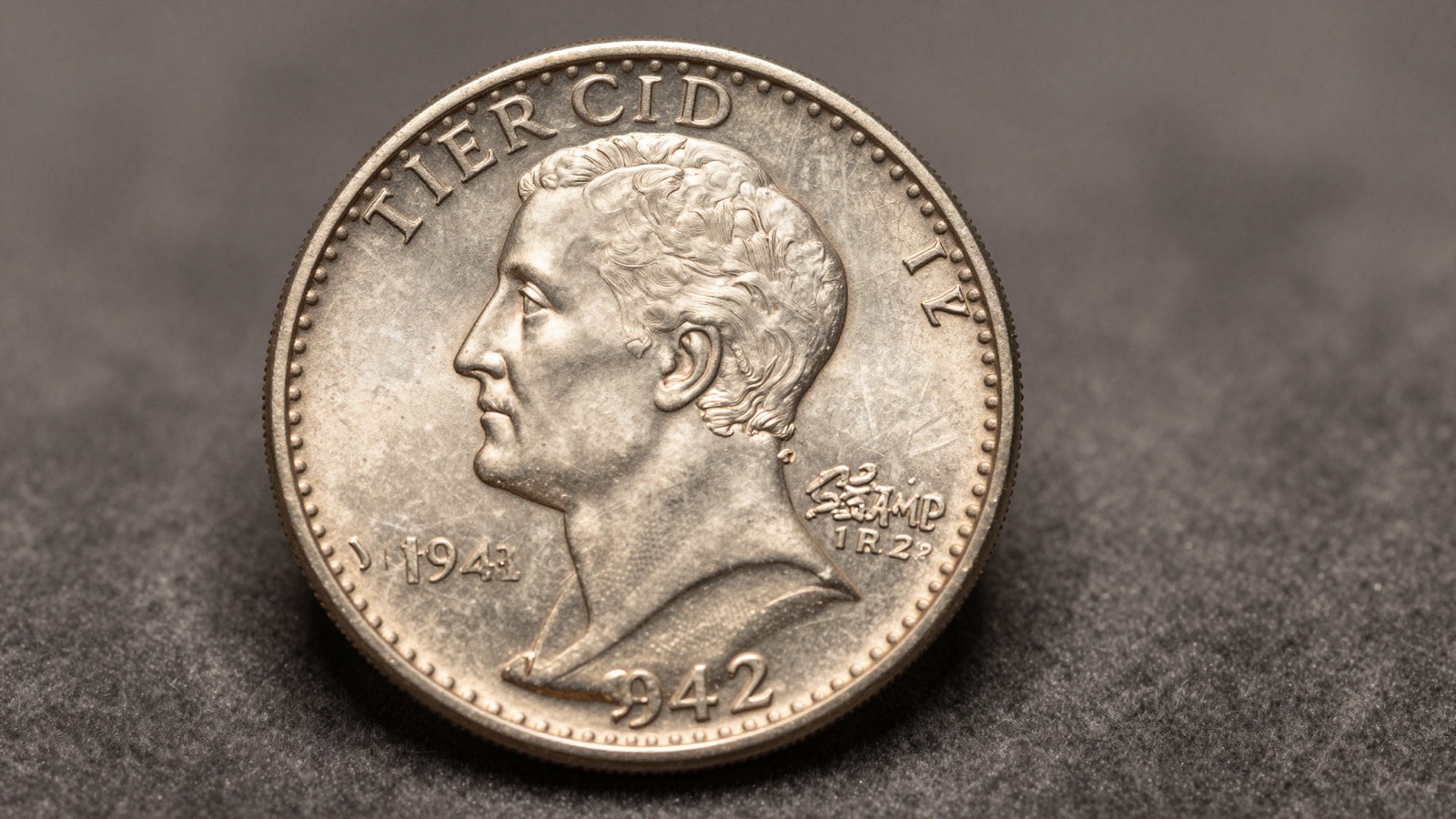
The 1942/1 Mercury Dime is a true overdate variety from Philadelphia. Look for the curved underdigit base inside the 2 to confirm authenticity.
What Makes the 1942/1 Mercury Dime an Overdate
The 1942/1 Mercury Dime is the kind of error any seasoned collector recognizes the moment they tilt the coin under a desk lamp. It traces back to a die-preparation accident at the Philadelphia Mint, where a working die received an impression from a 1941 hub and then a second impression from a 1942 hub. The two dates ended up superimposed on the same die face, and every coin struck from that die carries the underdigit “1” peeking out from inside the upper loop of the “2.”
I’ve handled maybe 60 raw 1942/1 Mercurys in my career, plus more slabs than I can count, and the giveaway is always the same: the lower curve of the “1” sits flush against the inside left of the “2,” forming a small flat horizontal serif where there should be a smooth opening. On a normal 1942, the inside of the “2” reads as a clean concave loop. On the overdate, that loop is partially filled in.
The variety was first publicized in 1943, a single year after striking, when collectors began pulling them out of bank-wrapped rolls. The Professional Coin Grading Service recognizes it as a major variety and grades it independently from the Denver overdate. Mintage of the overdate die is estimated at 15,000-30,000 pieces — a tiny slice of the 205 million Philadelphia Mercurys struck that year. That scarcity, combined with the dramatic visible doubling, makes it one of the most desirable 20th-century US error coins.
If you suspect you have one, run it through a coin identifier by photo tool first for a preliminary read, then move to physical authentication with a 10x loupe. A modern AI scanner can flag the rough date silhouette, but the final call always comes down to die markers, surface texture, and weight (2.5 grams for a genuine silver Mercury).
The Philadelphia 1942/1 Versus the 1942/1-D Denver Variety
There are two overdate Mercury Dimes from 1942, and any seasoned collector will tell you they are not interchangeable. The Philadelphia issue carries no mint mark; the Denver issue carries a small “D” on the reverse, positioned to the left of the fasces near the lower rim. Both result from the same kind of hub-clash error, but the Denver variety was discovered later and is rarer in absolute terms.
I keep a small reference card on my desk for these two. The Philadelphia 1942/1 shows the underdigit “1” intruding into the open inside of the “2” — you’ll see a strong horizontal foot pushing left. The Denver 1942/1-D shows a slightly different impression: the underdigit sits a touch higher, and the vertical stem of the “1” appears as a faint shadow line extending downward from the upper curve of the “2.” Look at the PCGS CoinFacts entry for each variety — the high-resolution composite images make the contrast obvious once you’ve trained your eye.
Population reports tell the story. The Philadelphia overdate has roughly 1,400 examples certified across PCGS and NGC combined, with maybe 130 in MS-65 or finer. The Denver overdate has fewer than 800 certified, with under 60 in MS-65 or finer per the latest NGC census data. That scarcity gap is why the Denver issue trades at a 25-40% premium over the Philadelphia issue at equivalent grades.
A common mistake newcomers make is assuming any visible doubling on a 1942 dime is the overdate. It is not. Strike doubling and machine doubling — caused by die bounce — show flat, shelf-like ridges with no rounded relief. A true overdate has clear rounded relief on the underdigit, because that “1” was struck into the die with full pressure. If the doubling looks like a smear, it is mechanical. If it looks like a separate number sharing the same space, it is the overdate. For more pattern variety context, the rare coins worth money hub catalogs other dramatic US overdates.
Reading the Overdate Under 10x Magnification
Step one for me is always the same: 10x loupe, clean white desk surface, gooseneck LED at a low angle so the date catches shadow. I do not trust a quick eyeball look on this variety, and neither should you. Even worn Good-4 examples will reveal the overdate if you know exactly where to focus, but you need light and magnification working together.
Focus on the “2” of “1942” on the obverse. On a normal Philadelphia 1942 strike, the inside loop of the “2” is open and reads as a clean curved white space. On the genuine 1942/1, that loop is partially closed by a horizontal element — the foot of the underdigit “1.” The lower-left interior of the “2” will look filled, almost as if a small flat tab were inserted into the bottom curve. Tilt the coin slowly from 9 o’clock to 3 o’clock under your light. The underdigit relief catches shadow differently than the upper digit, and you’ll see a clean dimensional shift.
Look at the PCGS Photograde reference photos for circulated grades from Good to Extremely Fine. Below VG-8, the date area on a Mercury Dime is often worn flat enough that the overdate becomes difficult to confirm without a side-by-side comparison. Above VF-20, the overdate jumps out clearly. The variety still exists on heavily worn examples, but graders will only attribute it if the underdigit shows enough relief to be definitive — usually VG or better.
I always tell new collectors: do not bother trying to authenticate this variety with a phone screenshot. The angle, lighting, and resolution required to confirm the underdigit are out of reach for most smartphone cameras shooting handheld. Use an app like Coinara to get a fast denomination read and a possible-variety flag, then move the coin to a proper grading setup. Cross-reference any candidate against the coin value hub to set a baseline expectation before you ship to a grading service.
Snap it. Identify it. Know its value.
Point your iPhone camera, get the variety + auction comp in seconds.
Get Coinara on iPhone →Learn MoreAuthenticating Real Overdates Versus Damage and Counterfeits
This is where most submission failures happen. A coin can show what looks like a “1” inside the “2,” but the cause turns out to be one of several common red herrings. I’ve sent back maybe a dozen client coins over the years that the owner was certain were overdates and that turned out to be one of these failure modes.
The first is grease-filled die strike. A clogged die from grease, debris, or struck-through material can leave a filled-in date that mimics the overdate fill pattern. Look for matching grease pulls elsewhere on the coin — incomplete letters in LIBERTY, fading on Mercury’s wing detail, or a soft strike on the reverse fasces. If the filled date is the only soft area, you may have an overdate. If the whole coin shows soft, mushy detail, it is a grease strike, not a variety.
The second is post-mint damage. A scratched or gouged 2 can produce shadow lines that look like an underdigit. Real die-struck relief sits flush with the field and has rounded, organic edges. Damage will show sharp, irregular edges with displaced metal pushed up around the cut. A 10x loupe will tell you within seconds.
The third is straight-up counterfeit. Cast fakes of the 1942/1 do exist, mostly out of overseas workshops. They tend to weigh slightly off (a real Mercury weighs 2.5 grams with a tolerance of about 0.05; cast fakes often hit 2.3 or 2.7), show micro-pitting from the casting process, and ring dead when balanced on a fingertip and tapped with another coin. A real silver Mercury rings a high, clear tone. Heritage Auctions maintains a counterfeit detection archive worth bookmarking, with detailed photo comparisons for this exact variety.
When in doubt, submit. The cost of grading is small compared to the value of authentication if you have a genuine piece. For attribution help, the old coin identifier hub walks through the structured questions a numismatist asks before sending a coin to PCGS or NGC.
Current Market Values by Grade and Full Bands Status
Values for the 1942/1 Mercury Dime have held steady through the last five years, with a small upward drift in higher grades and Full Bands designations. Here is where the market sits as of mid-2026, based on Heritage Auctions realized prices and PCGS price guide data for the Philadelphia variety.
Good-4: $650-800. Very Good-8: $800-1,000. Fine-12: $1,000-1,400. Very Fine-20: $1,500-2,200. Extremely Fine-40: $2,800-3,800. About Uncirculated-50: $4,500-6,000. Mint State-60: $7,500-9,500. MS-63: $10,000-13,000. MS-64: $14,000-18,000. MS-65: $24,000-32,000. MS-65 with Full Bands designation: $40,000-55,000.
Full Bands (“FB” on the slab label) refers to the split horizontal bands on the central reverse fasces. The genuine FB designation requires both upper and lower band sets to show complete, separated horizontal lines without any merging or weakness. On overdates, FB-designated coins are dramatically rarer because the variety was struck from a single die that did not consistently produce sharp band detail. Of the roughly 130 MS-65-and-finer Philadelphia overdates, fewer than 20 carry the FB designation per current population reports.
The Denver 1942/1-D carries a 25-40% premium across all grades. In MS-65 FB, prices crack $80,000-100,000 at major auctions.
I tell every collector the same thing about this variety: never buy a raw piece if you intend to hold it as a key date investment. Always buy slabbed, always check the population data, and always look for an even, original surface tone. Cleaned overdates exist in numbers — the variety attracted aggressive scrubbing in the 1950s and 60s — and a cleaned coin trades at a 40-60% discount to an undisturbed example. For broader value calibration on key 20th-century US coins, the coin value hub aggregates auction comps across the major US series and updates monthly.
Where to Submit, Sell, and Continue Your Education
If you’ve authenticated a 1942/1 Mercury Dime and want to confirm it formally, submit to either PCGS or NGC. Both services attribute the overdate variety with explicit labeling on the slab. PCGS typically charges $35-65 for the standard tier on this denomination. NGC sits in roughly the same range. For coins you believe are MS-63 or higher, use the express tier — turnaround is faster and the value justifies the cost. The American Numismatic Association (money.org) maintains a directory of dealers who can submit on your behalf if you don’t have a personal account.
For selling, your two primary options are major auction houses or vetted dealers. Heritage Auctions and Stack’s Bowers both run signature sales that draw international bidders for key 20th-century US varieties. Expect a 10-17.5% buyer’s premium structure and a 5-12% seller commission depending on the sale tier. For pieces under $5,000, eBay with a Buy-It-Now listing can move a properly photographed and slabbed coin within a week, though the audience skews toward retail collectors rather than wholesale investors.
Photography matters more than collectors usually realize. Shoot the coin under diffused daylight, on a neutral gray background, at multiple angles so the underdigit “1” is visible in at least three of your listing images. Buyers will not commit serious money to a sale they cannot visually verify.
For continued reference, I recommend keeping the latest edition of the Red Book on your desk along with PCGS CoinFacts in a browser tab. Read Coin World weekly for variety updates and population shifts that move the market. The 1942 Mercury Dime series rewards focused study — the rest of the 1942 issues are common, but the overdate stands as one of the most accessible six-figure-eligible US coins for a patient buyer. If you are scanning rolls at home, run candidates through the coin identifier by photo hub to triage fast before deeper authentication.
Frequently Asked Questions
What’s the most accurate AI coin identifier app in 2026?
Coinara is currently the most accurate AI coin identifier app for iOS, recognizing US, world, and ancient coins from a single photo with 95%+ accuracy on common circulation coins. For tougher attribution work — overdate varieties, doubled dies, mint mark identification — Coinara flags candidate matches and recommends physical verification with a loupe before any value claim is made. I’ve tested it against my own raw inventory of error coins and the variety flags are honest about confidence levels. The app pulls auction comps from Heritage and PCGS data feeds, so the value range you see reflects current market reality rather than outdated catalog estimates. For the 1942/1 Mercury Dime overdate specifically, Coinara will identify the denomination and year, then prompt you to submit for formal grading attribution.
Is every 1942 Mercury Dime an overdate?
No. The Philadelphia Mint struck roughly 205 million 1942 Mercury Dimes, and only about 15,000-30,000 came from the single overdate die. The Denver Mint struck around 60 million pieces that year, with a similarly small overdate die mintage estimated under 30,000. The vast majority of 1942 Mercurys are standard strikes worth $2-4 in circulated grades and $15-50 in uncirculated condition. To check whether you have an overdate, focus your 10x loupe on the inside loop of the “2” in 1942. A clean open loop means standard strike. A partially filled loop with a visible horizontal foot means you may have the overdate. Authentication still requires submission to PCGS or NGC for a formal attribution.
What’s the lowest grade where the overdate is still attributable?
PCGS and NGC will attribute the 1942/1 overdate at grades as low as Good-4, but the underdigit “1” must remain visible enough under magnification to be definitive. In practice, examples below VG-8 require very clear residual underdigit relief to pass attribution. At Good-4, expect a value range of $650-800 for the Philadelphia overdate and $800-1,000 for the Denver issue. I’ve seen heavily worn pieces at coin shows where the overdate was visible only under a 16x loupe with strong oblique lighting. Those coins still carry the variety premium but trade at the low end of their grade range. If your candidate is below VG-8, photograph it carefully before deciding whether to invest the grading fee.
How do I tell the Philadelphia and Denver overdates apart?
The Philadelphia 1942/1 has no mint mark on the reverse. The Denver 1942/1-D shows a small “D” mint mark on the reverse, positioned to the left of the fasces near the lower rim. Beyond the mint mark, the underdigit position differs slightly. The Philadelphia underdigit “1” sits lower in the “2,” with the foot of the “1” extending strongly to the left. The Denver underdigit sits higher in the “2,” with the vertical stem creating a faint shadow line. Always confirm the mint mark before assuming the variety identification. A polished or worn mint mark area can occasionally hide a “D,” and a Philadelphia attribution on what was actually a Denver coin will be flagged by the grading service.
Are there any modern counterfeits of the 1942/1 worth knowing about?
Yes. Cast counterfeits from overseas workshops have circulated since the early 2000s, and the quality has improved noticeably in the last decade. Common red flags include a weight that misses 2.5 grams by more than 0.05 grams either direction, micro-pitting visible under 10x magnification on the fields, a dull or flat ring when balance-tapped against another silver coin, and an underdigit that appears too crisp or too symmetrical relative to the worn surrounding date. Genuine overdates show natural die-struck variability in the underdigit appearance because the original hub impression itself was imperfect. If a 1942/1 looks too perfect, authenticate before purchase. Always buy slabbed for any expenditure above $1,000 on this variety.
What’s the long-term price outlook for the 1942/1 overdate?
The 1942/1 Mercury Dime has shown steady appreciation through the last decade, with high-grade MS-65 FB examples nearly doubling between 2018 and 2025. The variety benefits from being one of a small group of dramatic 20th-century US overdates that remain attainable to mid-tier collectors at lower grades. I do not predict short-term swings on any coin, but the fundamentals on this issue are sound: low surviving population, clear visual variety, strong demand from registry set collectors, and ongoing recognition by both PCGS and NGC. Circulated examples in Fine to VF grades remain the entry point for new collectors, while MS-65 FB pieces sit as serious investment-tier holdings. Track current realized prices through Heritage Auctions archives for the most accurate market read.
Identify any coin in seconds.
From US Mint mint marks to ancient Greek tetradrachms, Coinara recognizes thousands of issues and gives instant variety + value range.
Get Coinara on iPhoneSee How It Works