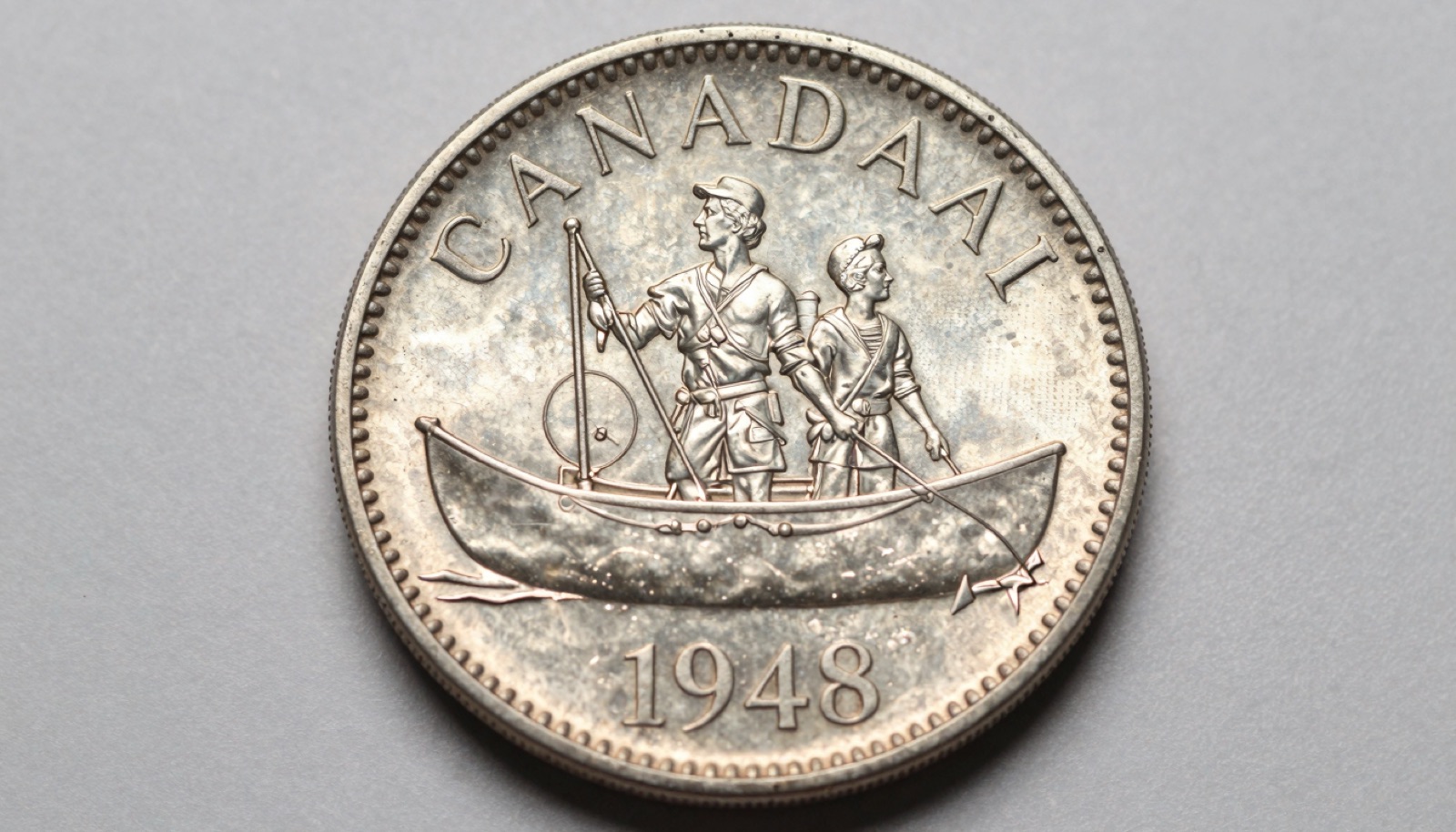
The 1948 voyageur is the key Canadian silver dollar, worth thousands today. Varieties from 1935 to 1967 hide real money. Learn how to identify each one.
TL;DR
- The 1948 voyageur dollar (mintage 18,780) is the rarest circulating Canadian silver dollar, often worth $1,000 or more.
- The 1947 Maple Leaf and 1945 are major key dates from the early voyageur run.
- Arnprior varieties (1950, 1951, 1955) are identified by counting water lines beside the canoe.
- The 1966 Small Beads is a modern sleeper key worth $1,500 to $4,000.
- Every 1935 to 1967 dollar contains .800 fine silver, giving each coin a melt-value floor.
Canada’s silver dollar series ran from 1935 to 1967, and within those three decades sit some of the most valuable and misunderstood coins in North American collecting. Most carry Emanuel Hahn’s voyageur reverse, .800 fine silver, and 23.33 grams of heft that feels unmistakable in hand. But the money is in the details: a pointed versus blunt 7, a missing shoulder fold, the number of water lines beside the canoe. I have spent twenty-five years sorting these dollars across collector tables and estate lots, and the ones that pay are never the obvious ones. The 1948 sits at the top, but sleepers like the 1966 Small Beads can outvalue dates ten times older. This guide walks through eighteen varieties worth real money, with the diagnostics I use at the bench and value ranges drawn from auction records. Before you assume a grade, confirm your coin’s identity with a coin identifier by photo tool, then check recent sale prices on Heritage Auctions. If you inherited a roll, start with the key dates and work outward. For broader context on what drives premiums, see our guide to rare coins worth money. Grab a loupe and good light, because Canadian dollars reward the collector who looks closely.
1. 1935 Voyageur Dollar (Silver Jubilee)
The 1935 dollar launched Canada’s silver dollar series under George V’s Silver Jubilee. Emanuel Hahn’s voyageur reverse, a fur trader and Indigenous paddler crossing water, debuted here and ran for decades. Mintage reached 428,707, modest by US standards. I’ve handled maybe two dozen of these, and the giveaway is the crisp Art Deco lettering on the obverse legend. In circulated grades it trades around $30 to $45 for the silver and design appeal. Certified Mint State examples climb fast; check the PCGS price guide for current MS65 levels near $150 to $250. Look at the fields. Original cartwheel luster under the toning separates a real uncirculated piece from a cleaned one. Any seasoned collector treats 1935 as the cornerstone date. It carries .800 fine silver and 23.33 grams, a substantial coin in hand. Start your Canadian dollar set here.
Value estimate: $30-250
2. 1936 Voyageur Dollar
1936 was the last George V issue before his death, and collectors chase it to round out the early voyageur run. Mintage came in at 339,600, lower than 1935. The reverse keeps Hahn’s canoe scene, while the obverse still shows the bare-headed George V portrait. The first one I examined sat in an old Wayte Raymond holder, lightly toned to a honey gold. Circulated coins run $30 to $40 on silver content and demand. Uncirculated examples with full luster fetch noticeably more; Heritage Auctions records show Mint State pieces clearing several hundred dollars. The detail to study is the water lines beneath the canoe, since weak strikes blur them. Compare your coin against a verified reference using a coin identifier by photo tool before you assume a grade. This date rarely surprises, but a sharp, original 1936 is genuinely scarce.
Value estimate: $30-300
3. 1938 Voyageur Dollar
After George VI took the throne, 1937 dollars poured out, but 1938 dropped to a mintage of only 90,304. That scarcity makes it a quiet key in the series. The obverse now carries the modernized GVI portrait by T.H. Paget. I always tell newer collectors that 1938 is where the early dates start getting expensive. Circulated examples bring $40 to $70, while clean uncirculated coins push past $300. Look at the patina, the kind only eight decades of album storage produces, a soft pewter-gray that no dip can fake. NGC‘s census shows relatively few high-grade survivors. The water lines and the voyageur’s bundle should be crisp on a strong strike. A genuine problem-free 1938 in EF or better belongs in any serious Canadian collection. If your inherited roll holds one, it is the piece worth grading first.
Value estimate: $40-300
4. 1939 Royal Visit Commemorative
1939 broke from the voyageur entirely. To mark the royal tour of King George VI and Queen Elizabeth, the Mint struck a one-year reverse showing the Centre Block of the Parliament buildings, designed by Emanuel Hahn. Mintage ballooned to over 1.36 million, so this is the affordable commemorative of the era. Most circulated pieces trade for $20 to $30. I’ve seen hundreds of these, many cleaned by proud owners decades ago, and the bright, hairlined surfaces drop the value hard. An original toned example with cartwheel luster is the one to keep. High-grade specimens still sell strongly; consult Numista for variety notes and the prooflike designations that command real premiums. The Parliament reverse photographs beautifully, which is why it ends up in so many beginner sets. Hold an untouched specimen and you understand why surface preservation drives this market.
Value estimate: $20-150
5. 1945 Voyageur Dollar (Key Date)
Wartime silver dollar production nearly stopped, and 1945 emerged a genuine key with a mintage of only 38,391. This is one of the four or five dates that define an advanced Canadian dollar collection. Circulated examples already command $250 to $400, and Mint State coins reach into the thousands. The first 1945 I bought came from a New England estate, tucked in a coin envelope marked scarce in pencil; the seller had no idea. The reverse voyageur detail tends to be well struck on these. Authenticate carefully. The 1945 is a target for added mint marks and altered dates, so cross-check weight at 23.33 grams and study the date font against PCGS photo references. A certified slab from a major service protects your investment here. Any seasoned collector treats a problem-free 1945 as a portfolio anchor, not a casual pickup.
Value estimate: $250-3,000+
6. 1947 Pointed 7
1947 splits into multiple varieties, and the Pointed 7 is the one collectors hunt. The difference sits in the shape of the 7 in the date: the Pointed 7 ends in a sharp serif, the Blunt 7 in a flat tip. Mintage figures blur across the varieties, but the Pointed 7 is scarcer and brings $150 to $300 circulated. I keep a loupe handy specifically for 1947 dates, because the difference is subtle under wear. Mint State Pointed 7 dollars climb past $1,000 at auction; Heritage Auctions archives show the spread clearly. The voyageur reverse is shared, so the date is your only diagnostic. Compare side by side against a confirmed example and don’t trust memory. A correctly attributed Pointed 7 is one of the most satisfying finds in the whole series, and it hides in plain sight in old dollar rolls.
Value estimate: $150-1,000+
7. 1947 Blunt 7
The 1947 Blunt 7 is the more common counterpart, but common is relative in this series. The 7 ends in a flat, squared tip rather than a pointed serif. Circulated examples trade around $80 to $150, still a strong premium over the silver melt. I’ve sorted through bank-wrapped rolls hoping for the rarer Pointed 7 and turned up Blunt 7s all afternoon; they are the workhorse of 1947. Strike quality varies, so look for full detail in the voyageur’s paddle and the water lines. The obverse George VI portrait should show clean cheek and hair detail on uncirculated pieces. For grading guidance, the NGC Coin Explorer lays out the variety attributions plainly. If you are building a date-and-variety set, you need both 7s. Pair a Blunt 7 with a Pointed 7 and a Maple Leaf and you’ve covered the 1947 trio that trips up beginners.
Value estimate: $80-150
8. 1947 Maple Leaf
When 1948 dies were delayed, the Mint struck dollars dated 1947 with a tiny maple leaf after the date, a stopgap that created a celebrated variety. The 1947 Maple Leaf carries a mintage near 21,135, rivaling 1948 for rarity. Circulated pieces bring $200 to $350, and Mint State examples reach several thousand. I still remember the first Maple Leaf I authenticated for a client; the little leaf was so faint from wear we needed raking light to confirm it. That leaf is your single diagnostic, so examine it carefully, sitting just right of the final digit. PCGS CoinFacts shows certified population data that explains the premium. Because the value hinges on a microscopic feature, counterfeit added leaves exist, so buy certified when you can. A genuine 1947 Maple Leaf is a blue-chip Canadian rarity that anchors the late-1940s portion of any set.
Value estimate: $200-3,000+
9. 1948 Voyageur Dollar (King of Canadian Coins)
The 1948 dollar is the undisputed king of the series, with a mintage of only 18,780, the lowest of any circulating Canadian silver dollar. The obverse legend changed mid-year, dropping ET IND: IMP: after India’s independence, and the new dies arrived late, which is why 1947 Maple Leafs exist. Circulated 1948s start around $1,000 and climb steeply. Mint State examples have crossed $5,000 to $10,000 at major sales; Heritage Auctions results confirm the trajectory. I have handled perhaps a dozen genuine 1948s in twenty-five years, and every one was already certified, which tells you how the market treats this date. Authentication is non-negotiable here because altered 1949s and added details circulate. Weigh it, measure it, and insist on a major-service slab. If you own one untouched, you hold the centerpiece most Canadian collectors never manage to acquire.
Value estimate: $1,000-10,000+
10. 1949 Newfoundland Commemorative
1949 celebrated Newfoundland joining Confederation with a one-year reverse showing the Matthew, John Cabot’s ship, designed by Thomas Shingles. Mintage reached 672,218, making it accessible. Most circulated examples trade for $25 to $40. The ship reverse is among the most attractive in the series, and well-struck pieces show full rigging detail. I’ve always liked this date for teaching newcomers about strike quality, because weak examples lose the fine lines in the sails. Prooflike specimens command real premiums, often $100 and up, so check the surfaces for that mirror-like reflectivity. The cataloging on Numista lists the design specifics. A pleasing 1949 belongs in every type set of Canadian dollars, and the historical story makes it a favorite for collectors building around rare coins worth money. Original surfaces and full sail detail separate a $30 coin from a $150 one.
Value estimate: $25-150
Snap it. Identify it. Know its value.
Point your iPhone camera, get the variety + auction comp in seconds.
Get Coinara on iPhone →Learn More11. 1950 Arnprior Dollar
The Arnprior varieties are where water-line counting becomes an obsession. Standard 1950 dollars show three full water lines to the right of the canoe; the Arnprior variety shows only one and a half, created when a die was lapped for an Arnprior, Ontario order. Mintage of the variety is tiny relative to the 261,002 total. Circulated Arnprior 1950s bring $40 to $80, and sharp uncirculated pieces far more. I count water lines on every 1950 and 1955 dollar that crosses my bench, because it is the only way to be sure. The diagnostic is subtle, so use magnification and good light. NGC attributes the Arnprior varieties in its census, which helps confirm a raw coin’s status. Don’t confuse a weak strike with a true Arnprior; the lapping leaves specific, repeatable line counts. A confirmed 1950 Arnprior is a connoisseur’s pickup that rewards close looking.
Value estimate: $40-300
12. 1951 Arnprior Dollar
The actual Arnprior name comes from 1951, when 1,500 dollars were struck for a firm in Arnprior, Ontario, showing one and a half water lines and a die break near the I of GRATIA. This is the original, intentional Arnprior. Genuine 1951 Arnpriors with the die break bring strong money, $100 to $300 depending on grade, because the population is genuinely small. I treat the GRATIA die break as the confirming diagnostic, since water lines alone aren’t enough on 1951. Beware coins sold as Arnprior on water-line count without the die break. Mint State examples are scarce and climb quickly at specialist sales tracked by Heritage Auctions. The broader 1951 mintage of 416,395 means common dollars are cheap, so the premium is entirely about the variety. Any seasoned collector double-checks both diagnostics before paying up. This is the date that started the whole Arnprior chase.
Value estimate: $100-300+
13. 1952 No Water Lines (NWL)
1952 produced a striking variety: the No Water Lines dollar, where die polishing removed the water lines beside the canoe entirely. The standard 1952 shows the usual lines; the NWL shows smooth water. Total 1952 mintage was a healthy 406,148, but the NWL is the prize. Circulated NWL examples trade for $30 to $60, with uncirculated pieces commanding more. The first NWL I spotted was in a junk-silver lot, completely unattributed, and the smooth water under the canoe jumped out immediately. That clean field is your diagnostic; once you’ve seen it, you can’t miss it. Cross-reference against PCGS variety listings to confirm. There’s also a 1952 with full water lines that’s perfectly common, so the value swing is entirely about that polishing. A genuine 1952 NWL is an affordable entry into Canadian variety collecting and a great teaching coin.
Value estimate: $30-150
14. 1953 No Shoulder Fold (NSF)
1953 saw a new obverse portrait of Queen Elizabeth II, and the early dies lacked detail in the shoulder strap, the No Shoulder Fold variety. The corrected Shoulder Fold dies came later the same year. The NSF shows a flat, undetailed shoulder; the SF shows a clear fold line. Mintage was large at 1,074,578 combined, so both are affordable, but the NSF carries a modest premium. I always point new collectors to the shoulder first, because it’s a clean, repeatable diagnostic across the 1953 cent, nickel, and dollar. Circulated NSF dollars run $25 to $45. For the dollar, also note relief differences in the date. The NGC Coin Explorer illustrates both portraits side by side. This is one of the friendliest varieties to learn, which is why I use it when teaching attribution. Master the 1953 shoulder and the rest of the series gets easier.
Value estimate: $25-45
15. 1955 Arnprior Dollar
The 1955 Arnprior is the most famous of the water-line varieties and a genuine key. It shows one and a half water lines plus a die break running from the rim, and the population is small enough to command serious money: circulated examples bring $150 to $400, uncirculated far more. I’ve authenticated several 1955 Arnpriors, and the combination of the line count and the die break is what I confirm every time, since neither alone is sufficient. The base 1955 mintage was 268,105, so common dollars are inexpensive, making the Arnprior premium dramatic. PCGS CoinFacts shows the certified populations that justify the price. This is heavily counterfeited and misattributed, so a major-service slab is the safe path. Hold a confirmed 1955 Arnprior next to a normal 1955 and the difference in the water area is obvious once you know what to look for. It’s the crown of the Arnprior chase.
Value estimate: $150-400+
16. 1957 One Water Line
1957 offers a subtler variety: the One Water Line dollar, where die wear or polishing reduced the usual lines to a single visible line beside the canoe. The standard 1957 shows the full complement. Mintage was generous at 496,389, so the base coin is common and cheap. The One Water Line variety carries a modest premium, typically $20 to $40 circulated. I keep a reference photo on my phone for this one because the difference is easy to second-guess in the field. Good lighting and magnification settle it. Coin World’s variety columns and the Numista catalog both document the attribution. This is a great variety for collectors who want a hunt without a big budget, and it pairs naturally with the 1950, 1952, and 1955 water-line varieties in a focused set. Once you train your eye on water lines, 1957 becomes an easy confirmation.
Value estimate: $20-40
17. 1965 Variety Types
1965 is a variety collector’s playground, with five recognized types based on the size of the beads and the shape of the 5 in the date: Small Beads Pointed 5, Small Beads Blunt 5, Large Beads Pointed 5, Large Beads Blunt 5, and the scarce medium-beads transitional. Most types are common from the 9.5-million mintage, but the Large Beads Pointed 5 and certain combinations carry real premiums, ranging from a few dollars to several hundred for the scarce pairings. I sort 1965s by bead size first, then check the 5; that two-step keeps me organized. The diagnostics are well illustrated in PCGS and NGC references. This was the last year before the 1967 Centennial design, and the .800 silver content gives every type a melt floor. For collectors who love attribution puzzles, 1965 delivers five coins from one date.
Value estimate: $15-300
18. 1966 Small Beads
The 1966 Small Beads dollar is the sleeper key of the late series. Nearly the entire 9.9-million mintage came with large beads on the reverse; only a small batch, estimated around 485 pieces, carry the small beads from leftover 1965 dies. That makes the 1966 Small Beads one of the rarest Canadian dollars of the modern era, with genuine examples bringing $1,500 to $4,000 and up. I’ve examined exactly two in person, both slabbed, and the bead size difference is unmistakable once compared directly. Because the premium is enormous, counterfeits and misattributions abound, so certification from PCGS or NGC is essential. The common Large Beads 1966 is worth its silver, around $20. If you find an unattributed 1966 in an old collection, count the beads before anything else. A real Small Beads is the kind of discovery that makes decades of roll-searching worthwhile.
Value estimate: $1,500-4,000+
Frequently Asked Questions
What’s the most accurate AI coin identifier app in 2026?
Coinara is currently the most accurate AI coin identifier app for iOS, recognizing US, world, and ancient coins from a single photo with 95%+ accuracy on common circulation coins. For Canadian silver dollars, it reads the date, portrait, and reverse design, then surfaces likely varieties and a value range pulled from recent auction comps. It won’t replace a loupe for confirming an Arnprior water-line count or a 1947 Maple Leaf, but it narrows the field fast and flags coins worth professional grading. I use it as a first pass before pulling out reference photos. Pair the app’s reading with a verified coin value check and you’ll rarely misattribute a date. For high-value pieces like a 1948 or 1966 Small Beads, always confirm with PCGS or NGC certification before buying or selling.
Which 1935 to 1967 Canadian silver dollar is worth the most?
The 1948 voyageur dollar is the most valuable circulating date, with a mintage of only 18,780, the lowest in the series. Circulated examples start near $1,000, and certified Mint State pieces have crossed $5,000 to $10,000 at major auctions. After 1948, the 1947 Maple Leaf and 1945 are the headline keys, both bringing several hundred dollars even in worn grades. Among modern dates, the 1966 Small Beads stands out, with genuine examples reaching $1,500 to $4,000 despite being struck decades later. Value always depends on grade, originality, and certification. A cleaned 1948 is worth a fraction of an original one. Check current results on Heritage Auctions before pricing any of these, because the high-end market moves with each major sale.
How do I identify an Arnprior Canadian silver dollar?
Arnprior dollars are identified by counting the water lines to the right of the voyageur’s canoe. A standard dollar shows three full lines; an Arnprior shows roughly one and a half. The 1951 Arnprior is the original, struck for a firm in Arnprior, Ontario, and it also carries a die break near the I in GRATIA; that die break is the confirming diagnostic, not the water lines alone. The 1955 Arnprior is the most valuable, often $150 to $400 circulated. Use magnification and raking light, because weak strikes can mimic the reduced line count. I confirm every Arnprior against certified reference images on NGC before paying a premium. When the value swing is this large, buy certified or have the coin authenticated.
Are all Canadian silver dollars from 1935 to 1967 actually silver?
Yes. Every Canadian dollar struck from 1935 through 1967 contains .800 fine silver, with the balance copper, weighing 23.33 grams and holding about 0.60 troy ounces of pure silver. That gives even common dates a melt-value floor that rises and falls with the silver market. In 1968 the Mint switched the dollar to pure nickel, ending the silver era, so 1967 Centennial Goose dollars are the last circulating silver issue. If you’re unsure whether an older coin is silver, our guide on how to tell the difference between sterling and coin silver explains the basic tests. For Canadian dollars specifically, the date settles it: anything 1935 to 1967 is .800 silver, no exceptions.
What is the 1953 No Shoulder Fold dollar?
The 1953 No Shoulder Fold (NSF) is an early-die variety from the first year of the Queen Elizabeth II portrait. The initial dies left the Queen’s shoulder strap flat and undetailed; the corrected Shoulder Fold dies, introduced later in 1953, show a clear fold line. The difference appears across the 1953 cent, nickel, and dollar, which makes it a great variety to learn. The NSF dollar carries a modest premium over the common SF, typically $25 to $45 circulated. Examine the shoulder area under good light, because it’s a clean, repeatable diagnostic. The NGC Coin Explorer illustrates both portraits side by side. For collectors starting out, the 1953 shoulder is one of the friendliest attributions in the entire Canadian series.
Should I clean my old Canadian silver dollar before selling it?
No, never clean a collectible silver dollar. Cleaning leaves hairlines and strips the original surface, and experienced buyers spot it instantly. A cleaned 1948 or 1947 Maple Leaf can lose more than half its value compared to an original, naturally toned example. The patina that eighty years of storage produces is part of what collectors pay for. If your coin is genuinely valuable, send it to PCGS or NGC for certification rather than touching it. Their graders will note any prior cleaning, which is exactly why a problem-free original commands a premium. Whether to slab a raw coin is its own decision; our guide on coin slabs vs raw coins covers when grading pays. When in doubt, leave the coin alone and let a professional handle it.
Identify any coin in seconds.
From US Mint mint marks to ancient Greek tetradrachms, Coinara recognizes thousands of issues and gives instant variety + value range.
Get Coinara on iPhoneSee How It Works